
It’s Not Just About Flavour
Why basil really belongs beside the tomatoes — and where the garden myth ends and the science begins

✦ Transparency note: This article was written by AI and reviewed by the author. All factual claims were independently verified (with another prompt) before publication. Mistakes may still happen.
Disclaimer: The information in this post is for educational and informational purposes only. It does not constitute financial, legal, or professional advice. The author is not liable for any financial loss or damages arising from use of this information. Data, pricing, and availability referenced here may be out of date — always verify independently before acting on it.
When the Spanish reached Tenochtitlán in 1519, the Aztec markets were stacked with plants they had no names for — fruits sold alongside chillies and cacao that would change European kitchens within a generation. Seeds made it back to Spain. Within a generation, the tomato had reached Italy. By the 1540s, the Italian botanist Pietro Andrea Mattioli had given it a name: pomo d’oro, golden apple — a reference to the golden and yellow-tinted varieties that appeared alongside red ones in the earliest European descriptions.
Nobody ate them. For nearly two hundred years, the tomato sat in Italian botanical gardens as a curiosity — beautiful, suspicious, and largely untouched.
Basil, meanwhile, had been in the Mediterranean for centuries. Brought from tropical Asia through Persian and Egyptian trade routes, it was already familiar to Greek and Roman cooks long before the New World existed on any European map.
These two plants did not know each other at all until the 18th century, when Neapolitan cooks finally began treating the tomato as food. The kitchen tradition came first. The garden tradition followed — someone planted basil beside the tomatoes, noticed the beds seemed healthier, and the folklore was born.
What they noticed, it turns out, had a biological basis. It just wasn’t the one they thought. 😮
🌿 What Basil Is Actually Doing in the Air
Basil (Ocimum basilicum) is a heavy producer of volatile organic compounds — aromatic molecules that evaporate continuously off the leaves and diffuse into the surrounding air. The main ones are linalool, methyl chavicol (estragole), eugenol, and 1,8-cineole, along with a shifting mix of other terpenes depending on variety, temperature, and time of day.
These are the compounds you smell when you crush a basil leaf. The key thing is they don’t stay in the leaf — they’re constantly releasing into the air, forming an invisible chemical cloud around the plant.
That cloud matters. Because insects don’t find their host plants by sight.
They find them by smell.
🔬 How Insects Actually Locate Your Tomato Plants
Pest insects — whiteflies, aphids, hornworm moths — navigate using chemical signals. Tomatoes broadcast their own volatile signature: a blend of hexenyl acetate, limonene, and specific terpenoids that essentially announces I’m a tomato, I’m here. Specialist pests have evolved over thousands of years to track exactly that signal with extraordinary precision.
When basil is planted nearby, its volatile cloud floods the same airspace. The signals mix and overlap. From a whitefly’s sensory perspective, the scent map becomes harder to read — like trying to follow a single conversation in a noisy room. The tomato is still there, but the chemical directions are blurred.
This mechanism — sometimes called olfactory interference or volatile camouflage — is the most likely biological explanation for basil’s companion value. Research on linalool and eucalyptol (1,8-cineole), the two dominant volatiles in Genovese basil that together account for the majority of its aromatic output, has confirmed insect-repellent activity in laboratory conditions. Field results are messier — wind, planting density, and temperature all affect whether the signal is strong enough to work consistently — but the underlying biology is sound. 🎯
🍅 The Two Pests It’s Targeting
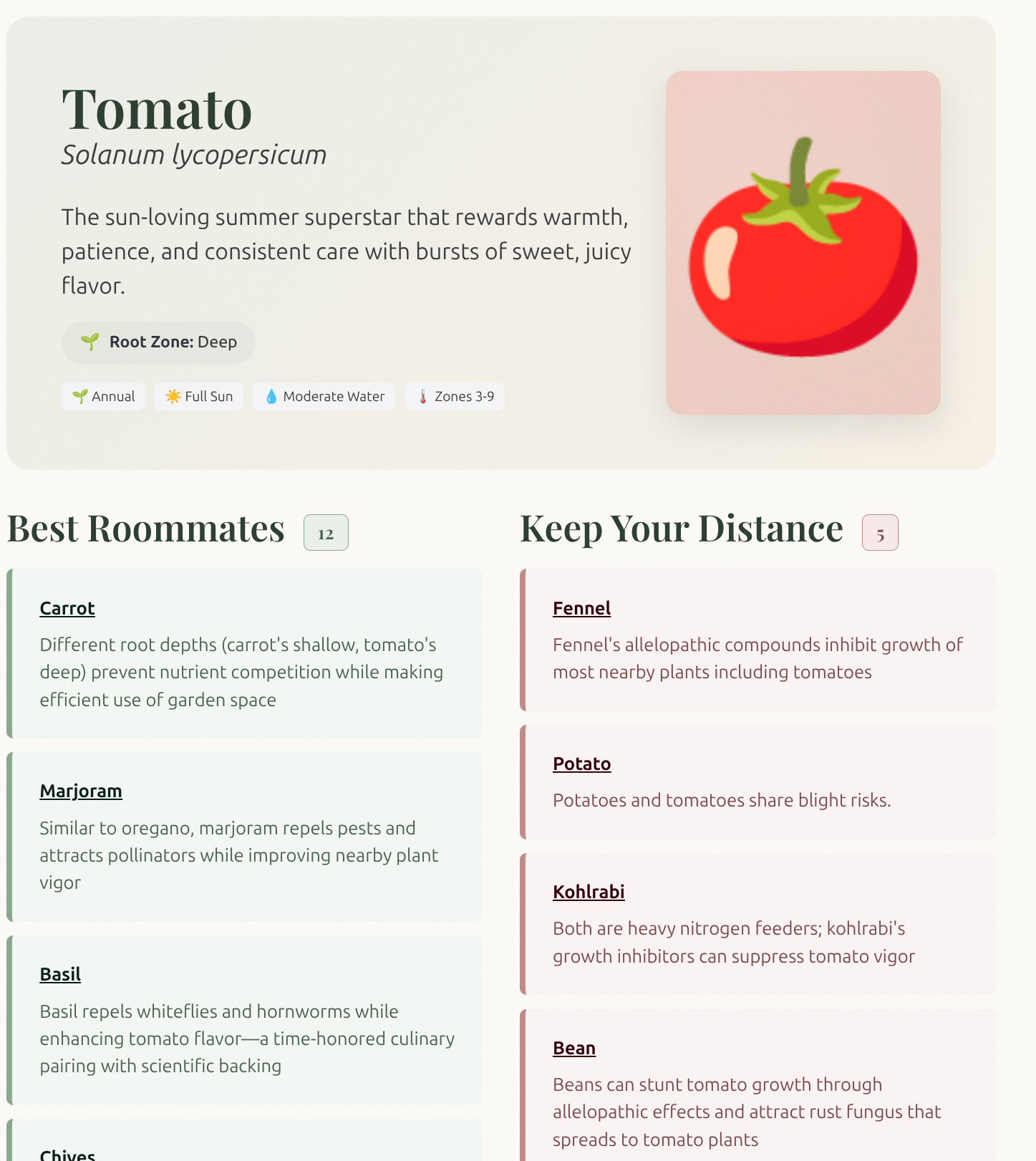
The rootmates.ovh tomato companion data lists basil as repelling two specific pests: whiteflies and tomato hornworms. These are real targets, but they work by different mechanisms.
Whiteflies (Trialeurodes vaporariorum and Bemisia tabaci) are sap-sucking insects that locate host plants chemically. Basil’s volatile interference disrupts their targeting — not eliminating them, but reducing how reliably they home in on the tomato plant. A mixed-volatile airspace makes the tomato harder to find on the first pass.
Tomato hornworms are the larval stage of the hawkmoth (Manduca quinquemaculata). The adult moths locate egg-laying sites using tomato volatiles. The disruption happens before the caterpillar even appears — basil’s effect is on the moth’s host-finding behaviour, not on the hornworm itself. A hornworm infestation always starts with a moth finding your plant in the first place. This is where the intervention matters most.
The practical implication: basil placed between tomato plants or at their bases works better than basil planted at the garden edge. You need the volatile cloud mixed directly into the tomato’s immediate airspace — not drifting in from a distance. 🌱
🌱 What Basil Doesn’t Do (The Myth Worth Correcting)
Here’s the part that surprises most gardeners: basil does not improve tomato flavour.
The belief is entirely understandable. In the kitchen, basil and tomato together are extraordinary — the flavour combination is one of the great pairings of Italian cooking. The culinary logic got projected backwards into the garden. If they taste so good together on the plate, surely they’re doing something for each other in the soil?
They’re not. Tomato flavour is determined by genetics, ripening conditions, water stress in the final weeks before harvest, and soil mineral content. A basil plant growing two feet away is not influencing any of those variables. No peer-reviewed study has demonstrated measurable flavour changes in tomatoes grown with basil companions.
This matters because companion planting carries a trust problem — so much advice circulates as received wisdom that it becomes genuinely hard to know what’s worth doing. The pest deterrence is real, if partial. The flavour improvement is kitchen poetry that migrated into garden folklore. 😼
Knowing the difference helps you plant with intention rather than superstition.
🌿 Which Basil Variety Actually Works Best
Not all basil performs equally as a companion. The volatile profile varies between varieties, and not all of them have the same linalool-dominant chemistry that most of the pest research focuses on:
Genovese basil — the classic large-leaf type; high linalool content; best studied for companion purposes; the default choice
Thai basil (O. basilicum var. thyrsiflora) — higher methyl chavicol; different aromatic profile; less researched for garden pest deterrence
Lemon basil (O. × citriodorum) — citronellal-dominant; different volatile signature; may be less effective for hornworm and whitefly targeting specifically
Dwarf and compact types — useful for dense interplanting directly at tomato bases without shading lower leaves
For companion planting purposes, Genovese basil is the safest choice. It’s what most of the research refers to, even when it doesn’t say so explicitly.
📋 Practical Notes for the Planting Bed
A few things that actually change how you set this up:
Timing lines up perfectly. Basil seeds start indoors 4–6 weeks before last frost — almost identical to tomatoes. Transplant both when soil reaches 60°F (15°C). They want the same conditions at the same time, which makes planning easy. 🗓️
Root depth means no competition. Tomatoes are deep-rooted; basil is shallow. They occupy completely different soil layers. This is one reason the pairing works well — you’re not robbing Peter to pay Paul.
Plant basil close, not at the border. 6–12 inch intervals between tomato plants, interplanted through the row, not just at the ends.
Pinch basil flower heads regularly. Once basil bolts and sets flowers, volatile output drops sharply as the plant redirects energy to seed production. Pinching keeps the aromatic effect going through the hottest weeks of summer — exactly when whitefly pressure peaks.
Keep basil away from fennel. The rootmates.ovh basil page flags fennel as allelopathically harmful to basil — fennel produces compounds that inhibit basil growth. These two should not share a bed.
Tomato spacing still matters. The rootmates.ovh tomato page specifies 24–36 inch spacing between tomato plants. Basil fills the gaps; it doesn’t replace the airflow tomatoes need.
🔧 Twelve Companions, Not Just One
Basil has the best story, but it’s not the only plant doing useful work alongside tomatoes. The rootmates.ovh tomato page lists 12 companions in total:
Marigold — suppresses soil nematodes through root exudate chemistry (a completely separate mechanism from volatile interference)
Nasturtium — acts as a trap crop, drawing aphids away from tomatoes onto itself
Borage — attracts pollinators and predatory insects; historically called the “companion plant of the garden”
Carrot — interplants without root competition, working at a different soil depth
Chives and onion — aromatic alliums that add to the volatile interference in the airspace
A bed with basil, marigolds, and nasturtiums is doing three different things simultaneously — above-ground volatile camouflage, below-ground nematode suppression, and aphid misdirection. That’s a system, not a pairing.
rootmates.ovh lets you look up companion planting combinations by plant — search any plant to see what grows well with it (and what doesn’t). Free to use.
🐾 Field Notes from the Feline Institute of Aromatic Intelligence & Unauthorised Herb Sampling
submitted by Chief Inspector Basilico, Head of Volatile Compound Verification
i conduct my assessment of the tomato bed every morning. 😼 this is a formal position. someone has to monitor the airspace situation and that someone is me.
the basil smells exactly like the kitchen counter when the human makes pasta sauce and then closes the kitchen door on me. this is suspicious. mrrp. i have flagged this.
i verified three basil plants this morning using my face. 🌿 pressed it carefully against each stem. held position for several seconds per plant. this is what verification looks like. i do not explain my methodology.
in row 3 there is one particular basil plant that smells extremely intense. something about the heat and the morning sun. i sat directly on top of it for eleven minutes. 😹 the data is excellent. the plant is slightly flat now but that is the cost of science.
the insects are behaving strangely near the aromatic area. they circle. they leave. this is correct. i reinforce this behaviour by staring at them from my monitoring position in the warm soil between the tomato rows. i do not blink. they feel it.
brrp. 🐾
the soil here is warm from yesterday and slightly damp from morning watering. i have chosen this location as today’s observation post. and napping site. these are the same thing. i monitor soil temperature from a reclining position. this is efficient.
Chief Inspector Basilico
Feline Institute of Aromatic Intelligence & Unauthorised Herb Sampling
“we smell everything. we share nothing.”
References
University of Florida IFAS Extension. Companion Planting in the Vegetable Garden. edis.ifas.ufl.edu
Cornell Cooperative Extension. Integrated Pest Management for Home Vegetable Gardens. Cornell University.
Royal Horticultural Society. Companion planting. rhs.org.uk
Pichersky, E. & Gershenzon, J. (2002). “The formation and function of plant volatiles: perfumes for pollinator attraction and defence.” Current Opinion in Plant Biology, 5(3), 237–243.
Plants of the World Online (Kew). Ocimum basilicum L. powo.science.kew.org
USDA PLANTS Database. Solanum lycopersicum L. plants.usda.gov
Kew Gardens. A History of the Tomato — botanical history of Solanum lycopersicum introduction to Europe. kew.org
Wikipedia. Tomato — history and etymology section (taxonomy and naming history). en.wikipedia.org/wiki/Tomato
📺 Watch: Basil and Tomato Companion Planting Explained
📚 Further Reading
If you want to go deeper on companion planting biology, Carrots Love Tomatoes by Louise Riotte is the most readable starting point — written in 1975, still widely cited, a solid framework even if some of its more folkloric claims deserve sceptical reading.
Carrots Love Tomatoes — Louise Riotte (Amazon)
As an Amazon Associate, I earn from qualifying purchases at no extra cost to you.
✦ About this article: Written by AI and reviewed by the author. All factual claims were verified (with another prompt) before publication. This is not professional horticultural advice — for site-specific guidance, consult your local university extension service. Companion planting data referenced here comes from rootmates.ovh and publicly available agricultural research.