
The Calendar That Predates Every App on Your Phone
Roman farmers were planting by moon phase in 65 AD. Biodynamic growers still do it today. Whether the science fully backs it or not, 2,000 years of independent practice is worth understanding.

✦ Transparency note: This article was written by AI and reviewed by the author. All factual claims were independently verified (at least with another prompt) before publication. Mistakes may still happen.
Disclaimer: The information in this post is for educational and informational purposes only. It does not constitute financial, legal, or professional advice. The author is not liable for any financial loss or damages arising from use of this information. Data, pricing, and availability referenced here may be out of date — always verify independently before acting on it.
Before almanacs. Before calendars. Before anyone had a way to write down a planting date — there was the moon. 🌕
It rises on a predictable cycle. It is visible from everywhere on Earth. It completes one full cycle every 29.5 days, ticking reliably through new, crescent, full, and back again, season after season, century after century. It requires no instrument to observe and no training to track.
For most of human agricultural history, it was the most practical clock available. And across cultures that had no contact with each other — Roman Italy, medieval Europe, traditional farming communities across Asia and the Americas — farmers independently concluded the same thing: the phase of the moon when you plant matters. 🌱
That belief is 2,000 years old in written form. It is still being practiced today. And the question worth asking isn’t whether it’s superstition — it’s why so many independent observers, across so many centuries, kept arriving at the same conclusion.
Columella and the Roman Farmer’s Calendar 📜
Sometime in the 50s or 60s AD, a Roman agronomist named Lucius Junius Moderatus Columella completed De Re Rustica — a twelve-volume encyclopedia of Roman agriculture that remains one of the most detailed practical farming guides to survive from antiquity.
Columella wrote from direct experience. He owned farms in Italy and Spain, grew up watching how crops behaved, and dedicated his life to documenting what actually worked. De Re Rustica covers soil types, fertilizers, viticulture, livestock, and the timing of every major farming task — including, systematically, the moon. 🌾
Across several books — particularly Book II (on field crops) and Book XI (the farm calendar) — Columella gives specific guidance on which moon phases favour different kinds of work:
Sow seed crops during the waxing moon, when the lunar light is growing
Harvest root crops and timber during the waning moon, when moisture in the plants is believed to be drawing downward
Avoid transplanting around the full moon, when plants were considered too saturated with moisture and vulnerable to shock
He was not writing in isolation. Virgil’s Georgics (c. 29 BC), composed nearly a century earlier, also contains lunar farming guidance — and farming traditions drawing on lunar timing predate both of them. But Columella documented it most thoroughly, and De Re Rustica was widely copied and read through the medieval period. 😮
That means the moon planting rules in use today trace a direct written lineage back nearly 2,000 years.
Why the Moon Makes a Useful Calendar 🌒
Here is the less mystical explanation for why lunar planting calendars spread and persisted.
The lunar cycle is 29.5 days — roughly one month. In temperate climates, a growing season runs approximately six to eight lunar cycles. That means a farmer can plan an entire season using nothing more than the visible phase of the moon as a time reference: plant the brassicas two days after the new moon, sow the root crops in the last quarter, harvest the grain at the waning gibbous.
The moon is also a reliable indicator of nighttime light levels. Full moon nights are bright enough to work by. New moon nights are dark. For cultures without artificial lighting, this was practically significant — it shaped when field work, harvesting, and processing could happen after sundown. 🕯️
And because the lunar cycle slightly precedes the solar month, following the moon forces a kind of discipline on timing — it prevents the common error of planting everything at once and spreads sowing across a longer window, which naturally reduces the risk of a single late frost wiping out an entire crop.
Whether or not gravity has any direct effect on seeds or sap, these structural benefits of the lunar calendar are real and practical. The moon is a genuinely useful clock for agricultural timing, independent of any other mechanism.
Rudolf Steiner, Maria Thun, and 50 Years of Data 🔬
In June 1924, the Austrian scientist and educator Rudolf Steiner delivered a series of eight lectures on agriculture at Koberwitz (in present-day Poland), at the request of a group of farmers concerned about declining soil health. Those lectures became the founding document of biodynamic agriculture — a farming system that integrates lunar and cosmic rhythms as practical inputs, not just tradition.
Steiner’s approach was systematic: he argued that plants respond not only to soil chemistry and sunlight, but to the rhythmic forces of the solar system, including the moon. His lectures gave biodynamic farming its theoretical framework. The empirical work came later.
Maria Thun (1922–2012) was a German biodynamic researcher who spent approximately fifty years conducting sowing trials keyed to lunar phases and positions. Starting in the 1950s, she planted identical crops on different days of the lunar calendar and recorded yields, germination rates, and plant quality. Her results consistently showed variation tied to lunar timing — root crops performed better when sown on “root days,” leafy crops on “leaf days,” and so on. 📊
Her annual Biodynamic Sowing and Planting Calendar, published continuously from 1963 until her death and carried on afterward, became the standard reference for biodynamic growers worldwide. It is still published today.
The scientific mainstream remains cautious: most controlled studies on lunar planting have not reached statistical significance, and the proposed mechanisms are disputed. 🧪 But Thun’s dataset — fifty years, consistent methodology, consistent results — is not nothing. Certified biodynamic farmland today covers over 250,000 hectares across more than 65 countries — a figure that only counts farms under the Demeter certification scheme, with many more uncertified practitioners worldwide. Some of the world’s most respected vineyards and market gardens operate biodynamically.
What the Moon Phase Planner Actually Tells You 🌓
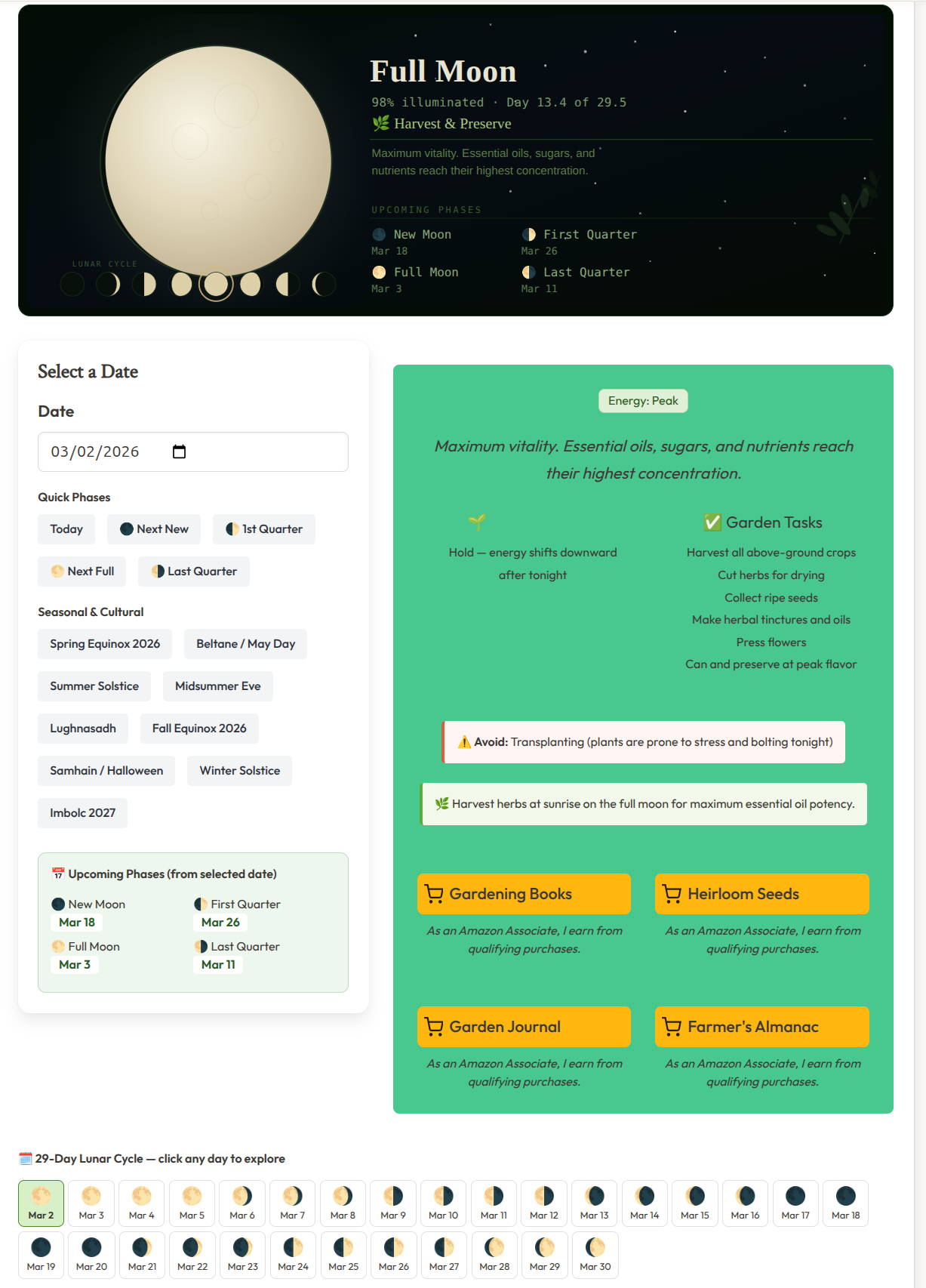
The Moon Phase Gardening Planner at riatto.ovh turns the 29.5-day lunar cycle into actionable gardening guidance, calculated from the J2000 astronomical reference — the same standard used in modern astronomy.
Rather than the basic four-quarter system, the tool uses an 8-phase breakdown for more specific guidance across the full cycle:
PhaseGardening guidanceNew MoonBegin preparing beds; avoid sowingWaxing CrescentSow leafy crops and annuals above groundFirst QuarterGood for sowing; strong upward growth energyWaxing GibbousTransplanting and grafting; high vitalityFull MoonPeak energy — avoid transplanting; ideal for harvesting herbsWaning GibbousHarvest root vegetables; sow root cropsLast QuarterPrune, weed, turn compost; soil restWaning CrescentRest period; prepare tools and plan
How to use it:
Open the planner and select today’s date — or use the Today quick button
Read your current phase, illumination percentage, and lunar energy level
Check the gardening recommendations for what to do (and what to avoid) this week
Use the 29-day lunar calendar to plan ahead — click any day tile to see its phase and guidance
Use the upcoming phase dates to schedule key tasks around the next new moon, first quarter, full moon, or last quarter
Seasonal presets let you jump directly to major dates across the growing year: Spring Equinox 2026, Summer Solstice, Fall Equinox 2026, Winter Solstice, and traditional seasonal markers like May Day, Midsummer Eve, and Imbolc 2027.
The moon SVG visualization morphs in real time as you move through the calendar — a satisfying way to develop an intuitive feel for where you are in the lunar cycle. 🌙
→ Browse biodynamic gardening and lunar planting books on Amazon
Affiliate disclosure: This post contains Amazon affiliate links. I may earn a small commission at no extra cost to you.
Who Uses This Today? 🌿
More growers than you might expect, across a wide range.
Home gardeners use it as a gentle planning framework — not a rigid rule, but a way to be more intentional about timing and to spread tasks across the month rather than cramming everything into one weekend.
Biodynamic farmers and market gardeners follow it as core practice, alongside other biodynamic preparations and soil-building techniques. Certified biodynamic produce commands significant price premiums in Europe, Japan, and increasingly in North America.
Winemakers — a disproportionate number of respected natural wine producers in Burgundy, Alsace, and the Loire Valley follow lunar planting and harvest calendars. Whether the results are due to the moon or to the overall rigour of biodynamic viticulture is an open question that sommeliers enjoy debating. 🍷
Foragers and herbalists time harvests by the moon, following the traditional logic that above-ground parts are most potent at the full moon and root material most concentrated at the new moon.
Wrapping Up 🎯
Columella wrote his moon planting instructions in 65 AD. Maria Thun spent fifty years testing them. Biodynamic farmers on several million hectares of land are following versions of the same calendar today. The moon has been humanity’s most reliable and universally visible clock for agricultural timing for longer than any written record reaches.
You don’t have to be a biodynamic purist to find the lunar calendar useful. Even treated as a simple planning framework — a way to space out sowing, structure the gardening month, and pay more attention to timing — it is more practical than ignoring it entirely.
The planner calculates where you are in the cycle and tells you what to do about it.
→ Try the Moon Phase Gardening Planner on riatto.ovh
References
Columella, L.J.M. (c. 65 AD). De Re Rustica, Book XI. (Public domain — multiple translations available via Project Gutenberg and LacusCurtius)
Steiner, R. (1924). Agriculture: An Introductory Reader (lectures delivered at Koberwitz, June 1924). Rudolf Steiner Press.
Thun, M. (1963–2012). Biodynamic Sowing and Planting Calendar (annual). Floris Books, Edinburgh.
Thun, M. (2003). Gardening for Life: The Biodynamic Way. Hawthorn Press.
🐾 Institute of Nocturnal Observation & Lunar Agriculture Research
i have been monitoring the moon from the windowsill every night for six years. 🌕
no one has thanked me for this. the research continues regardless.
the tool confirms what i have always known: the full moon is “peak energy.” i exhibit peak energy at the full moon. i also exhibit peak energy at 3am on tuesdays and when a bag crinkles in another room. the moon is one of several triggers. 😼
the waning crescent is designated a “rest period.” i have been observing the waning crescent by sleeping for nineteen hours and ignoring the human’s questions about it. this is called rigorous methodology.
the tool recommends avoiding transplanting at the full moon because plants are “vulnerable to shock.” i was moved to a new house at a full moon in 2022 and i am still processing it. columella was right. 🙀
current phase: waxing gibbous. high vitality. i knocked three things off the counter. the institute is satisfied with today’s data.
🐾 — Chief Observer Lunaris, Director of Windowsill Astronomy & Soil Rest Advocacy
About this article
This post was written by AI and reviewed by the author. All factual claims were verified (with another prompt) at the time of publication. Final perspective, editorial judgement, and any opinions expressed are the author’s own.Published on riatto.substack.com · March 2026