
The Gap That Changed Everything
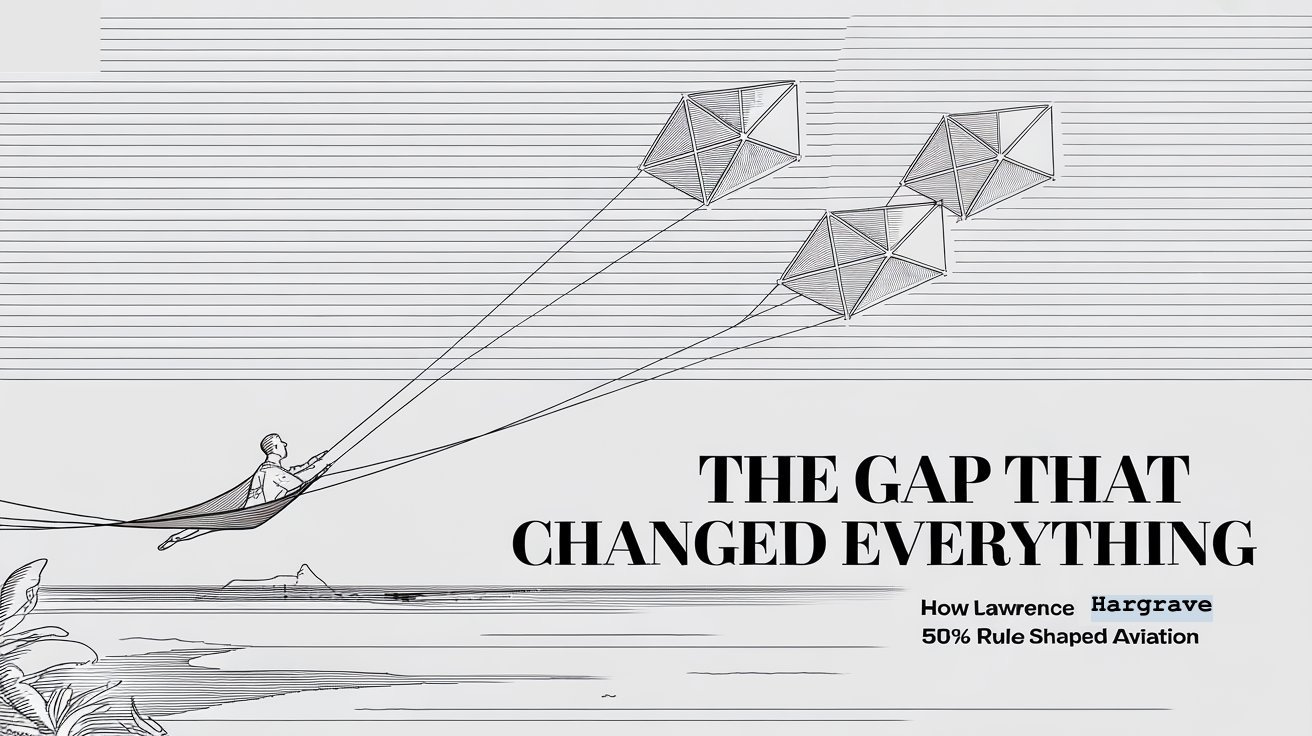
Lawrence Hargrave lifted himself off an Australian beach in 1894 using four kites he’d spent a decade designing.

He refused to patent any of it. The gap between those kite cells — exactly 50% of the chord — turned out to be one of the most productive numbers in early aviation history.
✦ Transparency note: This article was written by AI and reviewed by the author. All factual claims were independently verified (at least with another prompt) before publication. Mistakes may still happen.
Disclaimer: The information in this post is for educational and informational purposes only. It does not constitute financial, legal, or professional advice. The author is not liable for any financial loss or damages arising from use of this information. Data, pricing, and availability referenced here may be out of date — always verify independently before acting on it.
On the morning of 12 November 1894, a bearded man in a sling rose sixteen feet above Stanwell Park beach on the New South Wales coast. He was suspended beneath four kites flying in tandem. He had built every one of them himself. He recorded the altitude, sketched the rigging arrangement, and then came down.
His name was Lawrence Hargrave. He was forty-four years old. The beach stunt was not a spectacle — it was a proof. He was demonstrating, with his own body, that a cellular kite structure was stable enough to carry a human being through the air without spinning, tumbling, or collapsing. 🪁
He was right. And because Hargrave refused to patent a single thing he ever built, the aeronautical engineers who followed could use his findings freely.
The number at the heart of his box kite — the gap between its two cells, precisely half the effective chord — is still the number every box kite builder uses today. The Hargrave Box Kite Cell Rationer at riatto.ovh computes it for you in seconds, the same way Hargrave arrived at it through years of careful iteration on Australian beaches in the 1890s.
The Man Who Built Over a Hundred Flying Machines 🔬
Lawrence Hargrave was born in Greenwich, England, in 1850, the son of a judge. The family emigrated to Australia when he was fifteen. In 1878 he became an assistant astronomical observer at Sydney Observatory, a post he held for five years. In 1883 he left paid employment entirely and devoted the rest of his life to aviation research — self-funded, methodical, and relentless.
From 1884 onward, Hargrave built and tested over 100 flying models. He experimented with ornithopters (machines that flapped wings), monoplane gliders, and rotary engines. He invented a compressed-air rotary engine and published the design. He corresponded with aviation researchers across three continents. He kept meticulous records of every experiment.
His flat kites worked. They flew. But they had a persistent problem. ✨
Why Flat Kites Were Inefficient
A flat kite generates lift — but inefficiently. The surface acts like an inclined plane, deflecting air downward and rising in response. The problem is turbulence. The air flowing over the kite surface separates and becomes turbulent immediately downstream. If you fly two flat kites in a train — one behind the other — the rear kite sits in the chaotic wake of the front kite and generates dramatically less lift than it should.
The rear kite is, in effect, wasted material. It adds weight and drag. It contributes little lift.
Hargrave understood this. His solution was elegant: separate the two lifting surfaces not by stringing them one behind the other, but by building them into a single rigid structure with the correct gap between them. 😮
The gap does something specific. When air separates from the front cell and becomes turbulent, it needs physical distance to reattach into smooth, laminar flow again. Give it enough distance — roughly 50% of the chord width — and the flow reattaches cleanly before it reaches the rear cell. Both cells then generate full lift. The kite effectively doubles its lifting surface without doubling its instability.
This is the 50% rule. It is the heart of Hargrave’s 1893 design. The box kite was not a decorative novelty — it was an engineered solution to a real aerodynamic problem.
The 1893 Paper and the Open Hand 🤲
Hargrave published his box kite findings at the Royal Society of New South Wales in 1893. The paper — “Flying-machine motors and cellular kites”, published in the Journal and Proceedings of the Royal Society of New South Wales, Vol. 27 — laid out his geometry, his materials, his proportions, and his results. Everything a builder would need to replicate his designs.
He refused to patent any of it.
In correspondence and published remarks, Hargrave made his position clear: technical knowledge advanced faster when it circulated freely. Keeping designs secret for commercial advantage slowed everyone down, including the person keeping the secret. He believed the cumulative benefit of open sharing outweighed any individual financial gain.
He was not naive about this — he simply thought the maths pointed in that direction. 🎯
His reasoning had an interesting parallel with a decision made in Boston thirty years earlier. When Oliver Wendell Holmes Sr. redesigned the stereoscope viewer in 1861, he also refused to patent it and published the design openly in The Atlantic Monthly — calling it “no toy: it is a divine gift, placed in our hands by science.” (Covered in The Victorian Toy That Put the Whole World in 3D on this Substack) Two inventors, a generation apart, making the same unusual calculation: give it away and the world moves forward faster.
Hargrave’s box kite designs entered circulation immediately. Researchers everywhere built from them.
Weather Services, Wire Trains, and the Upper Air 🌤️
The first wide-scale application of Hargrave’s box kite had nothing to do with human flight. It had to do with the weather.
By 1898, meteorological services in Australia, the United States, and Europe were using trains of box kites to lift instruments into the upper atmosphere. A single box kite could lift a small anemometer or thermometer to altitude. A train of four or more box kites, flown in series on a long steel wire, could reach several kilometres.
This was the first practical method ever developed for measuring temperature, humidity, and wind speed above ground level. Before kite trains, meteorologists had no direct access to upper-air data. They could observe clouds, measure surface conditions, and extrapolate — but they couldn’t know what was actually happening at 2,000 metres. ☁️
Box kites changed that. The United States Weather Bureau established kite observation stations across the country from 1898, lifting meteorographs to altitudes of up to 3 kilometres on trains of four or more kites. The programme ran until around 1909, when weather balloons took over. The kites used were built to Hargrave’s proportions — cubic cells, 50% gap, bamboo or light timber spars — because those proportions produced the most reliable lift in the widest range of wind conditions.
It was unglamorous, systematic, scientific work. Hargrave would have approved.
The Biplane Connection ✈️
In the same years that weather bureaus were flying kite trains over their stations, a small community of aviation researchers was studying Hargrave’s cellular designs for a different purpose: figuring out how to build a powered flying machine.
The American engineer Octave Chanute — who maintained one of the most extensive correspondence networks in the aviation world — was a devoted reader of Hargrave’s published work. In 1896, Chanute built a series of biplane gliders explicitly based on the structural principles of the box kite: two lifting surfaces, separated by struts, with the spacing calculated to prevent one surface from disrupting the airflow over the other.
Chanute’s biplane glider of 1896 — built with Augustus Herring, using truss-based railroad engineering principles — was the most stable aircraft anyone had yet built. It flew hundreds of times without incident at the Indiana dunes. Chanute shared his findings openly, in the same spirit as Hargrave.
He shared them, in particular, with Wilbur and Orville Wright. 🎯
The Wright Flyer of 1903 was not a box kite. But its biplane structure — two wings, separated vertically, each contributing full lift — descended directly from the cellular kite principle Hargrave had published a decade earlier. The geometry was different. The underlying insight was the same: keep both lifting surfaces in clean air, and you double your lift without doubling your drag.
Hargrave appears on the old Australian $20 banknote — issued from 1966 to 1994 — alongside an engraving of his gliders. It is an unusual honour for an inventor who gave everything away. Then again, perhaps that is precisely why.
The Hargrave Box Kite Cell Rationer 📐
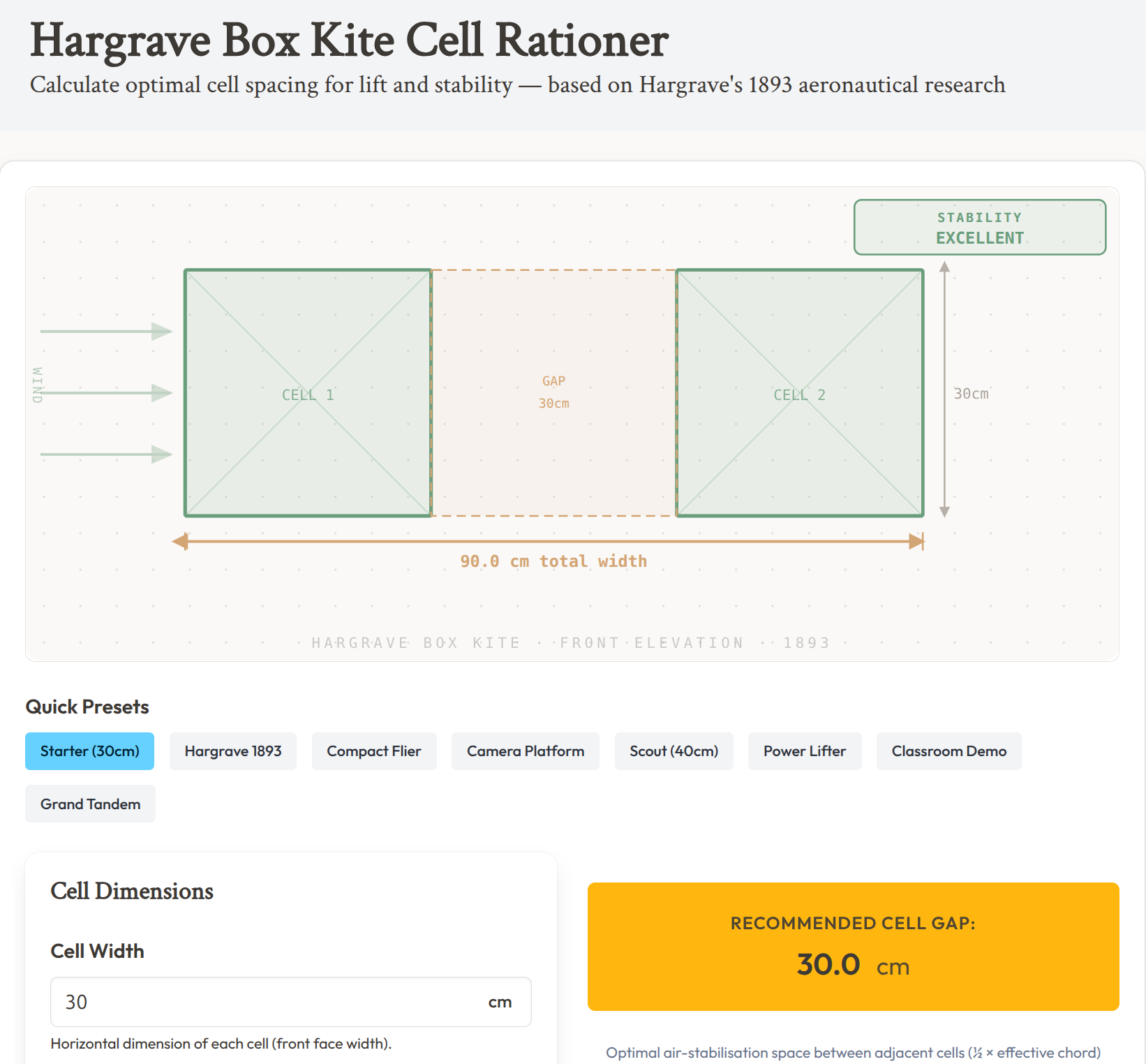
The Hargrave Box Kite Cell Rationer at riatto.ovh applies Hargrave’s 1893 proportions directly. Enter your cell dimensions and cell count, and it calculates the correct gap in real time.
Inputs:
Cell Width (cm) — the width of a single rectangular cell
Cell Height (cm) — the height of a single rectangular cell
Cell Depth (cm) — the front-to-back depth of a single cell
Cells (Horizontal) — how many cells sit side-by-side
Cells (Vertical) — how many cells are stacked
Outputs:
Effective Chord — total lifting span, calculated as cell width × horizontal count
Recommended Cell Gap — 50% of the effective chord; the key number
Overall Kite Width — the full horizontal footprint of your kite
Overall Kite Height — the full vertical footprint
Stability Rating — ranges from Poor to Excellent based on how well your proportions align with Hargrave’s optimal ratios
Quick Presets:
Starter (30 cm) — a small first build at a manageable scale
Hargrave 1893 — the original proportions from Hargrave’s published design
Compact Flier — optimised for light winds and easy transport
Camera Platform — large, stable configuration for lifting a lightweight action camera
Scout (40 cm) — a mid-size build good for open fields
Power Lifter — maximised cell count for pulling capacity (aerial measurement, banner lifting)
Classroom Demo — sized for indoor demonstration with calm air
Grand Tandem — multi-cell configuration, closest to Hargrave’s 1894 beach setup
Materials Guide:
The tool includes a materials reference for spars and cell fabric:
Ripstop Nylon — cell fabric; light, tear-resistant, best all-round choice
Carbon Fibre Rod — spars; best strength-to-weight ratio, stiff and reliable
Fibreglass Rod — spars; budget option, good flex for beginners
Bamboo — spars; authentic period material, Hargrave’s original choice
Tyvek — cell fabric; waterproof, very light, can be sourced from packaging envelopes for free
For historical accuracy, the Hargrave 1893 preset uses bamboo spars and waxed cotton cell fabric — the materials Hargrave had access to on the New South Wales coast in the 1890s. For modern builds, carbon fibre and ripstop nylon dramatically reduce weight while maintaining the same geometry.
→ Browse box kite building and kite design books on Amazon
Affiliate disclosure: This post contains Amazon affiliate links. I may earn a small commission at no extra cost to you.
The Number Behind the Kite 🔢
The 50% gap rule deserves a moment of attention, because it is both simple and non-obvious.
If your kite has two cells, each 30 cm wide, flying side by side, the effective chord is 60 cm. The recommended gap is 30 cm — exactly half. Intuitively, this feels like a lot. You are building a gap the same size as one of your cells. It looks as if you are wasting space.
You are not wasting space. You are buying clean air.
The turbulent wake behind the front cell extends roughly half a chord length downstream before it reattaches. A gap shorter than that puts your rear cell inside the turbulence — and an aerodynamic surface inside turbulence is like a sail in calm water. It looks like it’s working. It barely is. 😮
A gap at exactly 50% puts the rear cell at the point where laminar flow has just restored. Both cells operate at full efficiency. The kite is as light as it can be while lifting as much as it can.
Hargrave arrived at this ratio empirically — building, flying, measuring, adjusting. The tool computes it instantly. The ratio is the same either way.
Craftsmanship Across Disciplines 🎯
Box kite geometry has something in common with a piece of joinery: both depend on precision ratios, both were developed through years of empirical refinement, and both produce results that are visually clean and structurally sound in exactly the right proportion.
The dovetail joint (covered in The Joint That Held for 5,000 Years) relies on an angle that is calculated from material properties — too steep and the wood splits; too shallow and the joint pulls apart. Hargrave’s gap works the same way — too small and the lift collapses; too large and the structure becomes unwieldy. In both cases, the right number is not obvious until you understand what is happening physically, and once you understand it, the number feels inevitable.
This is a recurring pattern in well-designed tools: the insight is in the ratio.
Wrapping Up 🪁
Hargrave spent the 1880s and 1890s testing flying machines on Australian beaches, refusing every suggestion that he patent his work or guard his findings. He believed that useful knowledge accelerated in the open and stagnated behind closed doors. He published everything.
The box kite that rose to 16 feet at Stanwell Park in November 1894 proved three things simultaneously: that the cellular structure was stable, that the 50% gap rule produced genuine lift, and that a human body could be carried aloft on kites built to Hargrave’s proportions.
Meteorologists used those proportions to probe the upper atmosphere. Biplane designers used the underlying principle to build aircraft that could actually fly. Hargrave received little financial reward and declined the commercial opportunities that did come his way.
The geometry he published is still correct. It still works. The Hargrave Box Kite Cell Rationer computes the same gap Hargrave used in 1893 — no guessing, no trial and error, no adjustment for materials that were not yet invented.
→ Try the Hargrave Box Kite Cell Rationer on riatto.ovh
🧩 Interactive Crossword
👉 Play the The Gap That Changed Everything Crossword
Three clue modes: Standard · Humorous · Solaris 🐾
Open the Crossword →
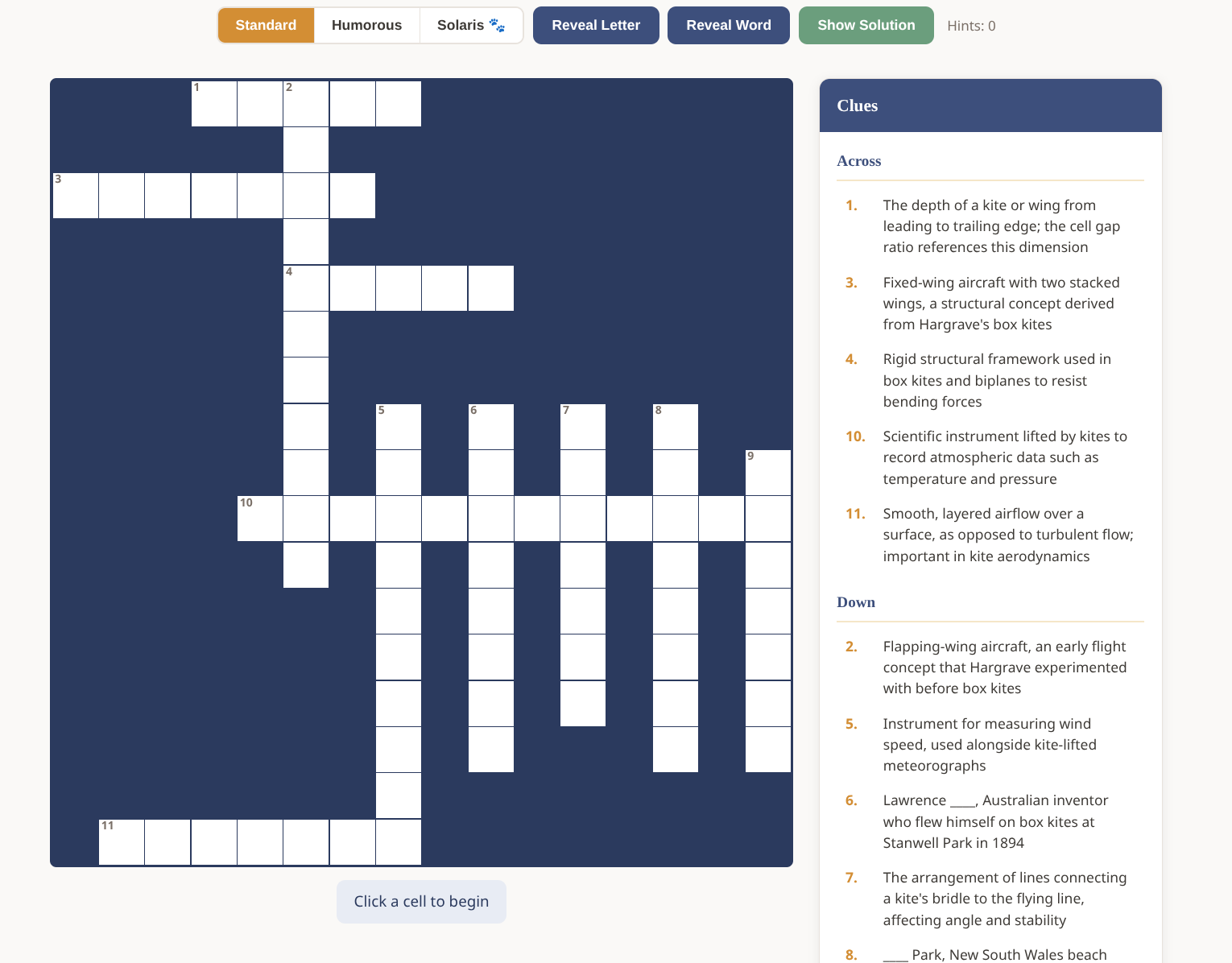
11 words · Auto-layout crossword · Reveal hints available · Works on mobile
References
Hargrave, L. (1893). “Flying-machine motors and cellular kites.” Journal and Proceedings of the Royal Society of New South Wales, Vol. 27, pp. 75–81. (Public domain)
Chanute, O. (1894). Progress in Flying Machines. The American Engineer and Railroad Journal, New York. (Public domain)
National Weather Service / NOAA — History of Upper-Air Observations: vlab.noaa.gov (US Weather Bureau kite programme, 1898–1909)
Gibbs-Smith, C.H. (1960). The Aeroplane: An Historical Survey of its Origins and Development. HMSO, London. (Reference)
Lawrence Hargrave Society: lawrencehargrave.org
🐾 Aerial Surveillance Division & Institute of Gap-Based Turbulence Research
i have studied this tool carefully. i have also studied the gap between the couch and the wall, the gap between the counter and the fridge, and the gap behind the bookshelf where the mouse went last tuesday. 😼
gap research is a serious field. hargrave took years. i have been doing it since i was six weeks old.
the 50% chord rule makes complete sense to me. you need clean air before you commit. this is exactly why i sit completely still for four minutes before leaping onto anything. i am not hesitating. i am waiting for the turbulence to reattach. 🎯
the stability rating of “excellent” on the hargrave 1893 preset is impressive but also predictable. of course the proportions are optimal. he spent a decade on them with bamboo and waxed cotton. i would have sorted it out faster but i was busy with the mouse situation.
i have assessed the camera platform preset. a kite capable of lifting a camera is, in theory, capable of lifting a cat. i am available. the fee is: one anchovy per metre of altitude. 🐟
the tool does not currently have a preset for this configuration. i have submitted a feature request via the method of sitting on the keyboard.
🐾 — Chief Inspector Zephyr, Aerial Surveillance Division & Institute of Gap-Based Turbulence Research
About this article
This post was written by AI and reviewed by the author. All factual claims were verified (with another prompt) at the time of publication. Final perspective, editorial judgement, and any opinions expressed are the author’s own.Published on riatto.substack.com · March 2026