
The Math Most Schools Leave Out
A new book by Sizu Riatto traces every number, operation, and equation back to the ordinary person who needed it first — and finally answers the questions most math classes never got to.


✦ Transparency note: This article was written by AI and reviewed by the author. All factual claims were independently verified (with another prompt) before publication. Mistakes may still happen.
Disclaimer: The information in this post is for educational and informational purposes only. It does not constitute financial, legal, or professional advice. The author is not liable for any financial loss or damages arising from use of this information. Data, pricing, and availability referenced here may be out of date — always verify independently before acting on it.
There was a moment — probably somewhere between secondary school algebra and whatever came next — when math stopped making sense and you stopped asking why.
The teacher wrote on the board. You wrote in your notebook. You memorised the procedure. You passed, or didn’t. And somewhere in that process, quietly, you filed yourself under “not a math person” — as if that were a fixed trait rather than a completely rational response to being handed a rule with no explanation attached.
That’s the argument at the centre of Math Didn’t Have to Be This Hard: The Ancient Thinking Tools They Forgot to Teach You, a new book by Sizu Riatto, now available on Amazon KDP. And the argument is not gentle. It’s specific: the reason math felt hard for most people wasn’t aptitude. It was that the why was almost never part of the lesson.
📖 The Thesis: Every Idea Was Invented by Someone Who Needed It
The book opens with a claim that sounds obvious until you actually sit with it: every concept in mathematics was invented by an ordinary person with a concrete problem they couldn’t solve without a new idea.
Not a mathematician theorising in isolation. A farmer. A merchant. A navigator. A tax collector. Someone staring at a problem that the existing toolkit couldn’t handle, who had to reach for a new thought.
Negative numbers weren’t invented by an academic. They were invented because debt exists — because there is a thing called “you owe more than you have” and you need a way to write it down without it becoming ambiguous. Fractions weren’t a theoretical exercise. Land doesn’t always divide evenly, and when it doesn’t, you need to know what each person gets. Logarithms — the ones that scared more people out of mathematics than almost anything else — were invented by a mathematician in the early 1600s who spent roughly twenty years solving one urgent problem: navigators at sea couldn’t do large multiplications fast enough to stay alive. The logarithm was a speed tool. A life-saving shortcut.
When you know that, the logarithm isn’t a mystery. It’s an obvious response to a problem you can picture. Of course someone invented this. It solves exactly that problem. That click of recognition — that sense of of course — is what this book is after.
🏗️ How the Book Is Structured
Math Didn’t Have to Be This Hard moves in three deliberate stages.
Stage one: the numbers themselves. Before operations, before equations, the book asks what numbers actually are. Not how to use them — what they are and why they exist. This covers territory most people were never given:
Before Numbers — how quantity was tracked without a number system, and why that turned out to be insufficient
Zero — the idea that took multiple independent civilisations to arrive at, because it requires thinking of “nothing” as a thing
One — deceptively obvious; far stranger than it appears
Negative Numbers — philosophically rejected for centuries; finally made unavoidable by medieval merchants who needed to write down debt
Fractions — the practical solution to the problem of uneven division
Infinity — not a large number, but something categorically different; the mathematician who proved that some infinities are larger than others nearly destroyed his own career for doing so
Stage two: the operations. Addition, subtraction, multiplication, division — what you were taught to do with numbers, with almost no explanation of what those operations are actually modelling or why the rules work the way they do. There is a reason multiplication is commutative. There is a reason order of operations is standardised the way it is. Neither reason is complicated. Neither was ever explained to most people.
Stage three: the abstractions. Variables, equations, functions, graphs. This is where a significant number of capable people quietly started faking it — because the moment the letters appeared, the familiar footholds disappeared. The book’s argument is that these ideas aren’t harder than what came before. They’re just further from the familiar. The distance is shorter than it looks.
After the three main stages, four chapters go deeper: prime numbers and their role in modern encryption; logarithms and why the volume knob on your amplifier isn’t linear; pi and the unsettling number of places it appears that have nothing to do with circles; and statistics — how to read a number and know whether it means what someone is claiming it means.
🔢 A Taste of What’s Inside
Four chapters stand out as particularly worth flagging, not because the others are lesser, but because these tend to surprise people who thought they already knew the territory.
Zero turns out to have a history most people have never encountered — one that reframes what seems like the simplest number in the system. The chapter asks a question most math classes skip entirely, and the answer changes how the whole system looks.
Logarithms is the chapter most people expect to bounce off, and don’t. The backstory of how and why logarithms were invented — who needed them, and what was at stake — is one of the more striking in the book. It makes the concept land in a completely different place than the version most people half-remember from school.
Infinity covers the proof that nearly destroyed a mathematician’s career. The result itself is astonishing. The presentation makes it followable — the book earns that claim rather than just asserting it.
Statistics may be the most useful chapter for daily life. The angle isn’t calculation — it’s protection. How to read a number that someone is presenting as evidence, and know what to ask before you trust it.
🧭 Who This Book Is For
The preface is clear: you don’t need any particular background. You don’t need to remember anything from school.
If anything, the rules you learned might be a mild obstacle — because the book is trying to replace remembered procedure with actual understanding, and the two occasionally conflict. A reader arriving with no prior math education would have less to unlearn.
The likely reader is someone who got through school-level mathematics via memorisation, arrived somewhere in adult life with a lingering unease about whether they really understood any of it, and has occasionally wondered whether there was a version of these ideas that would actually make sense. That reader will find a book written directly for them.
The book will also be useful — in a different way — for people who understood the procedures but never knew the history. Knowing where a concept came from changes how it sits in the mind. The history isn’t decoration. It’s the fastest path to genuine understanding.
📚 The Quick Reference and What Comes After
The book includes a Quick Reference section — a condensed summary of key formulas, definitions, and relationships across all eighteen chapters — designed to function as a standalone refresher without needing to return to the full chapter.
An extensive bibliography of primary and academic sources backs every historical claim in the book, followed by a comprehensive index. This is not a casual gesture at research — it’s a book that stands behind its history.
🔗 Explore the Concepts Further
Some of the ideas in this book have their own dedicated posts and interactive tools on riatto.substack.com — good companions for readers who want to go hands-on with the underlying concepts.
The Sequence That Wasn’t Fibonacci’s
The same math-history storytelling approach, applied to one of the most famous number patterns in mathematics — tracing it back to the scholars who arrived there centuries before Fibonacci, and the geometry that explains why it shows up everywhere in nature. Pairs naturally with the book’s chapters on numbers and pattern.
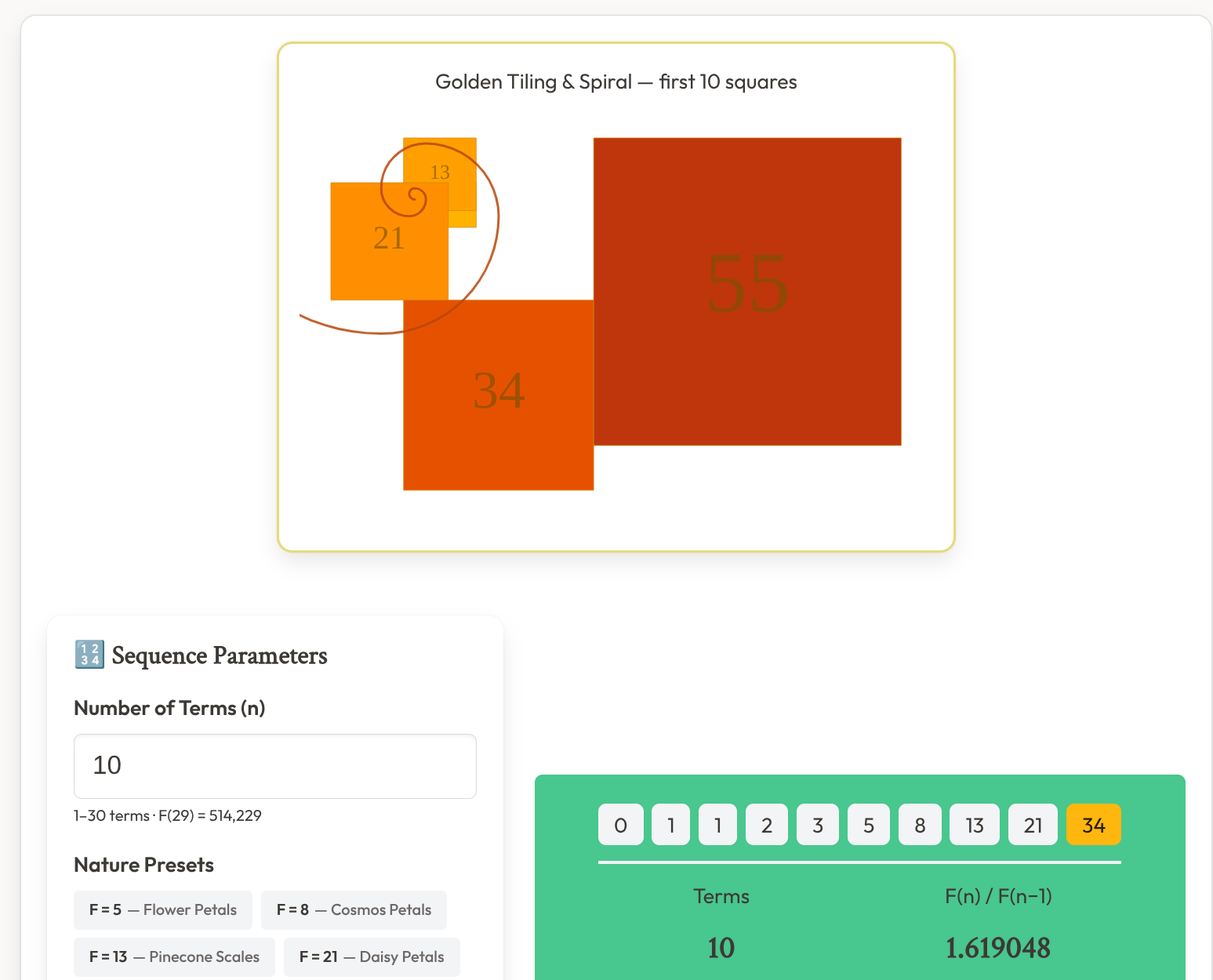
→ Read the post · → Try the Fibonacci Generator
The Numbers That Outlasted Rome
Roman numerals make a brief but telling appearance in the book’s chapter on Zero — as the cautionary example of a numeral system that never developed a way to write nothing. This post explores that system in full, including why it lasted as long as it did and where it still shows up today.
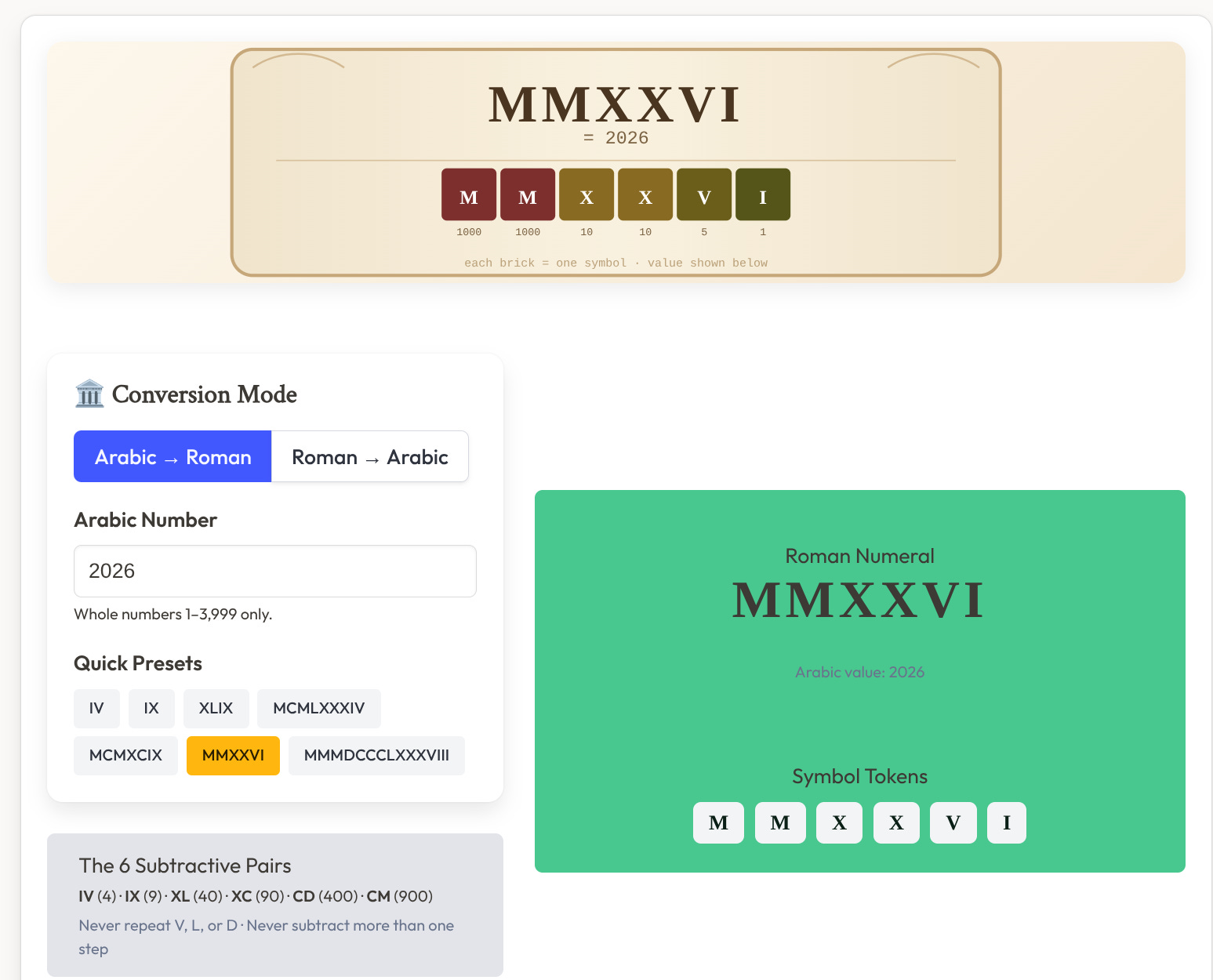
→ Read the post · → Try the Roman Numeral Converter
The Coin That Tamed Uncertainty
Probability is Chapter 14 in the book. This post approaches the same territory from the story of a mathematician flipping coins by hand in a Danish prison camp — and an interactive simulator that lets you run the same experiment and watch the pattern emerge in real time.
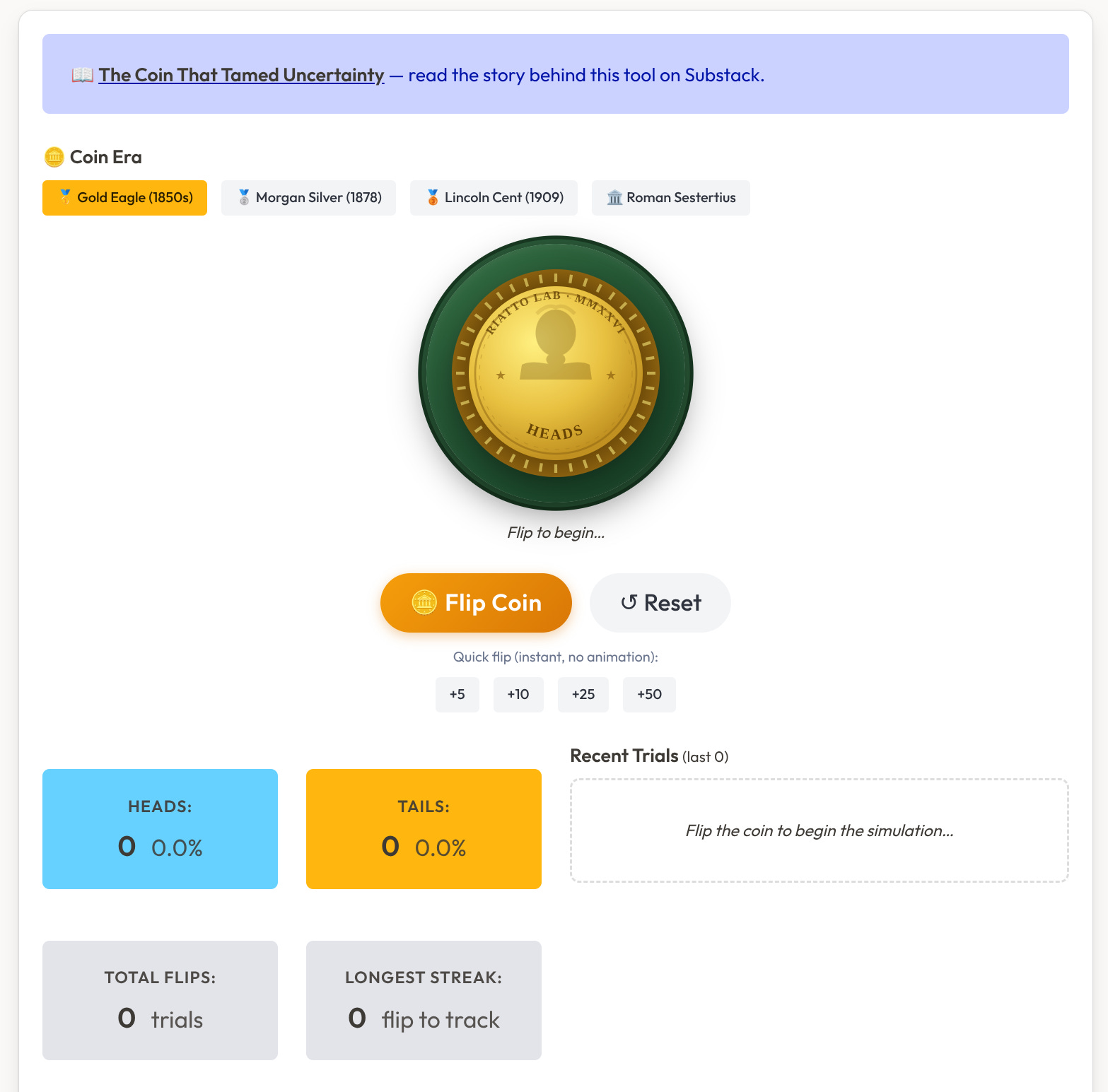
→ Read the post · → Try the Coin Flip Simulator
🐾 Briefing from the Institute for Feline Mathematical Intuition and Strategic Snack Procurement
Filed by Senior Analyst Calculus, Bureau of Quantity Assessment and Bowl Monitoring
i have reviewed the book Math Didn’t Have to Be This Hard on behalf of the Institute. 😼 my findings are as follows.
the central claim is that math was invented by ordinary beings with real problems. i find this plausible. i also have real problems. specifically: my bowl is often empty at times that do not correspond to any reasonable feeding schedule. i have been attempting to model this mathematically. my current equation does not balance. mrrp.
the chapter on zero was of particular interest. the concept that “nothing” is a number. i understand this. when there is nothing in my bowl, that is a quantity. it is the quantity i am most familiar with. it is still, somehow, not treated with the mathematical seriousness it deserves. 🐾
the chapter on negative numbers made an impression. the book explains that debt requires negative numbers — you need a way to write down that you owe more than you have. i have reviewed my treat deficit from the past seven days. the number is negative. it is significantly negative. i have not received acknowledgement of this figure. i am considering escalating.
the logarithms chapter described a volume knob. i am aware of volume knobs. when the music is too loud, i leave the room. when i leave the room, the music becomes quieter. this is not a coincidence. i believe this may be logarithmic. the Institute is reviewing the data. chirp.
the statistics chapter noted that a number without context is not information. i found this validating. when told i have “plenty of food,” i now request the standard deviation. chirp. 😹
my overall assessment: the book is thorough, clear, and addresses questions that should have been answered many years ago. it would benefit from a chapter on the mathematics of snack timing optimisation. i have prepared an outline. it has not been requested. it remains available.
four and a half paws out of five. the half paw is withheld pending further review of the bowl situation.
Senior Analyst Calculus
Institute for Feline Mathematical Intuition and Strategic Snack Procurement
“every empty bowl is a data point. we have a lot of data.”
Where to Get It
→ Get the book on Amazon - Math Didn’t Have to Be This Hard: The Ancient Thinking Tools They Forgot to Teach You is available now on Amazon KDP.
Also available in the series:

Logic Didn’t Have to Be This Hard: Clear Thinking for Everyday Life
Affiliate disclosure: This post contains an Amazon affiliate link. I may earn a small commission at no extra cost to you.
References
Riatto, Sizu. Math Didn’t Have to Be This Hard: The Ancient Thinking Tools They Forgot to Teach You. Amazon KDP, First Edition, 2026. Primary source for all chapter summaries and book descriptions in this post.
Napier, John. Mirifici Logarithmorum Canonis Descriptio. Edinburgh, 1614. Original publication of logarithm tables; context for the Logarithms chapter discussion.
Cantor, Georg. “Über eine Eigenschaft des Inbegriffes aller reellen algebraischen Zahlen.” Journal für die reine und angewandte Mathematik, 77, 1874. Original paper on the uncountability of real numbers; context for the Infinity chapter discussion.
Seife, Charles. Zero: The Biography of a Dangerous Idea. Viking, 2000. Background on the history of zero.
Wikipedia. Logarithm — history, Napier, Briggs, and applications. en.wikipedia.org/wiki/Logarithm
Wikipedia. Georg Cantor — biography and reception of set theory. en.wikipedia.org/wiki/Georg_Cantor
Wikipedia. History of the Hindu–Arabic numeral system — origin and transmission of positional notation including zero. en.wikipedia.org/wiki/History_of_the_Hindu%E2%80%93Arabic_numeral_system
About this article
This post was written by AI and reviewed by the author. All factual claims were verified (with another prompt) at the time of publication. Final perspective, editorial judgement, and any opinions expressed are the author’s own.Published on riatto.substack.com · March 2026
Tags: #math #books #education #history #science