
The One Number Every Weaver Needs to Know
Seven thousand years ago, someone set the first warp too tight and ruined their cloth. The formula that prevents this is pure geometry — and it fits in a single calculation.

✦ Transparency note: This article was written by AI and reviewed by the author. All factual claims were independently verified (at least with another prompt) before publication. Mistakes may still happen.
Disclaimer: The information in this post is for educational and informational purposes only. It does not constitute financial, legal, or professional advice. The author is not liable for any financial loss or damages arising from use of this information. Data, pricing, and availability referenced here may be out of date — always verify independently before acting on it.
There is a moment that every new weaver remembers: you spend an afternoon threading your loom, tie on your warp, and begin to pass the shuttle through. The shed opens. The weft slides in. You beat it down.
And the fabric is wrong. Either the weft can barely squeeze between the warp threads — the whole thing is rigid before you’ve woven a single inch — or the threads are so spread out that the cloth has no structure at all, flopping limp off the beam like a loose net. 😩
The warp has to come off. You start again.
The problem is not technique. It is a single number you didn’t know to calculate: the sett — how many warp threads per inch your loom should carry for the yarn you chose and the fabric structure you intended.
Get it right before you thread, and everything else follows. Get it wrong, and no amount of skill at the loom will save you.
The Oldest Calculation in Textile-Making 🧵
The word “sett” in its textile meaning dates from the late 1600s. It comes from the same root as the plain English word set — from Old English settan, meaning “to place” or “to fix.” The sett is literally the setting of the loom: the fixed density at which the warp is arranged before a single weft thread passes through.
But the problem the sett solves is far older than the word. 🕰️
The earliest known plain weave textiles date to around 7,000 BC. At Çayönü Tepesi in southern Turkey, archaeologists found the imprint of a plain-weave cloth preserved on a bone tool — the fabric itself long gone, but its structure frozen in the surface. Those ancient weavers were already dealing with the same constraint: how closely can you pack the warp threads and still leave room for the weft to interlace? Pack them too tight, and the cloth seizes. Leave them too loose, and the weft falls through gaps instead of locking into place.
Twill weave — the diagonal rib structure you see in denim, herringbone, and tartan — appears in the archaeological record across the ancient world, with clear evidence in Bronze Age fabrics from Egypt, the Near East, and Central Asia. 🌍 Whoever developed it discovered something important: twill threads can sit closer together than plain weave threads, because the diagonal float means each crossing point involves fewer interlacings per inch. A denser warp is possible. But “how dense?” still required an answer.
For most of weaving history, that answer was acquired through years of apprenticeship. Master weavers knew from experience what worked for a given yarn and structure. 👴 They taught it to journeymen who taught it to apprentices. The knowledge lived in their hands, not in numbers.
The systematic formula — derive the sett from the yarn’s measured thickness — came later, when weaving instruction needed to be written down and transferred to people who had no master to learn from.
The Geometry Hidden in the Rule 📐
The rule that modern weavers use is deceptively simple:
Sett for plain weave = Wraps Per Inch ÷ 2
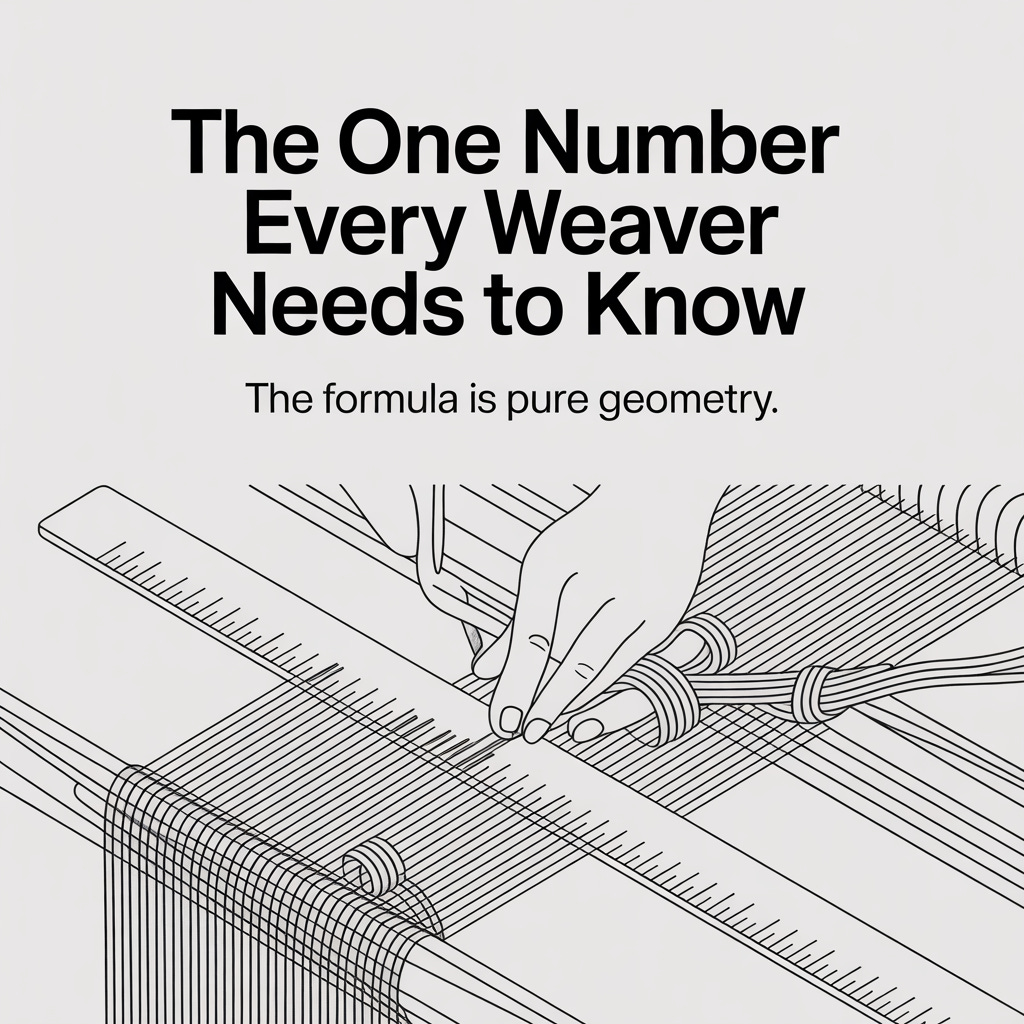
Measure how many times your yarn wraps snugly around a one-inch section of ruler, divide by two, and that’s how many threads per inch your warp should carry.
It sounds arbitrary until you see what it’s actually describing. 🎯
When you wrap yarn around a ruler edge-to-edge, each wrap sits against the next. Every wrap takes up exactly one yarn-width of space. So if you get 24 wraps in an inch, your yarn is 1/24 of an inch thick.
In plain weave, the weft goes over one warp thread, under the next, over the next, and so on. For this interlacing to work, each warp thread must have approximately its own diameter of clear space next to it — room for the weft to slip through and beat down. ✂️
Sett at 12 threads per inch (half of 24), each thread occupies 1/24 of an inch and the gap beside it is also 1/24 of an inch. Warp and gap alternate perfectly. The weft fits. The weave interlocks. The fabric is balanced.
The WPI ÷ 2 rule is not a weaving rule. It’s a geometry rule. The weavers who codified it were describing a physical relationship between yarn diameter and interlacing clearance. The formula would be the same whether you derived it from a weaving manual or a geometry textbook. 🔬
Why Different Structures Need Different Setts 🧩
The geometry shifts when the weave structure changes — and this is where most beginners hit a second surprise.
Twill weave (the diagonal rib) allows a denser sett than plain weave. In a basic 2/2 twill, each thread goes over two and under two, which means fewer interlacing points per inch. The weft doesn’t need to squeeze through a gap at every thread — it floats over two at a time. You can pack the warp closer together. The rule of thumb: sett ≈ WPI ÷ 1.5, or roughly two-thirds of your WPI. This is why denim and tweed feel so solid and dense compared to muslin or tabby linen — it’s the same weight of yarn, just woven at a different sett for a different structure.
Tapestry flips the relationship entirely. 😮 In tapestry weaving, the weft covers the warp completely — the warp threads are meant to disappear inside the cloth. This requires spreading the warp threads out so the weft can pack in tightly between them, row after row, concealing the structure underneath. The tapestry sett is the low end of the sett range for a given yarn — just enough threads to hold the weft in place, widely spaced so the weft can lie flat on top.
Rug weave (weft-faced) takes this even further. A functional rug needs to withstand foot traffic and repeated wear, which means an extremely dense weft pack. The warp is set at the lowest practical density — just enough to provide structure — while the weft is beaten in so hard that it covers everything. The sett for rug weaving is the lowest number the tool will suggest for any given yarn.
Four structures. Four sett formulas. One underlying principle: how much space does the interlacing require?
The Weaving Sett Calculator 🔢

The Weaving Sett Calculator at riatto.ovh does the arithmetic for you — which matters more than it sounds, because the formula changes with every yarn and every structure. Doing it wrong costs an afternoon of threading. ⏱️
How to measure your WPI:
Wrap your yarn snugly (not stretched, not slack) around a ruler for exactly one inch, counting each wrap as it sits side by side. Count the wraps. That number is your WPI.
Inputs:
Yarn WPI — your measured wraps-per-inch count
Weave Pattern — Plain Weave, Twill (2/2), Tapestry, or Rug (weft-faced)
Outputs:
Loom Sett (TPI) — threads per inch for your chosen structure
Warp threads — total count for a 10-inch wide sampler
Nearest standard reed — suggested dent size from common available reeds (5, 8, 10, 12, 15, 18, or 20 dents per inch)
Picks per inch (PPI) — how many weft rows per inch for a balanced fabric
The reed suggestion is particularly useful. You can calculate a theoretically perfect sett of 14 threads per inch, but if your nearest reed is a 15-dent, the tool tells you that immediately — rather than after you’ve already ordered supplies. 🛒
Project presets (auto-populate both fields):
Wool Scarf — medium weight wool, plain weave starting point
Linen Runner — linen at table runner density, plain weave
Silk Tapestry — fine silk, tapestry structure
Cotton Towel — kitchen/bath cotton, plain weave
Wool Rug — heavy wool, weft-faced rug structure
Alpaca Shawl — lightweight alpaca, plain weave
Twill Blanket — medium weight wool, 2/2 twill
Tapestry Sample — medium yarn, tapestry structure for a sampler
→ Browse handweaving books on Amazon
Affiliate disclosure: This post contains Amazon affiliate links. I may earn a small commission at no extra cost to you.
What the Number Unlocks 🔓
Knowing your sett before you thread the loom changes what you can plan.
Once you have your threads-per-inch, a 10-inch-wide sampler becomes a concrete shopping list: total warp threads, reed size, approximate yarn yardage. A full blanket at 60 inches wide becomes a real project with real numbers attached. The guesswork of “is this warp tight enough?” becomes a verification: measure, wrap, calculate, confirm.
It also explains why handweavers talk about “sett” as a design choice, not just a technical constraint. 🎨 A weaver choosing a slightly looser sett than the formula suggests is making a deliberate decision: a softer drape, more open texture, a fabric that breathes differently. A tighter sett makes denser cloth with more body. The formula gives you the baseline. What you do around it is where craft comes in.
Seven thousand years of weavers figured this out by feel, by mistake, and by apprenticeship. The formula distills it into a single number you can verify before the first thread goes on the beam. ✅
Try It
→ Open the Weaving Sett Calculator on riatto.ovh
Free to use. No sign-up required.
References
Weaving — Wikipedia (history of plain weave and twill structures)
Plain Weave — Wikipedia (structure and origins)
Sett n. — Online Etymology Dictionary (origin of the word)
🐾 Bureau of Warp Surveillance & Unauthorized Yarn Acquisition
i was sitting on the loom. 😼 just sitting. investigating the structural integrity of the warp threads with my entire body weight. this is important quality work and i do not appreciate being removed.
the human wrapped yarn around a ruler. counted the wraps. said something about “wraps per inch.” i watched this very carefully. the yarn moved. i moved too. the human said “no.” i said nothing because i am a professional. 😤
the calculator gave a number. threads per inch. i considered this number. i knocked the ruler off the table. the number was unchanged. mrrp. 🐾
the reed arrived in a long flat envelope. i sat on the envelope for twenty-two minutes while the human waited. this is called quality assurance. it is called this because i say so. 😹 when i finally permitted access, the reed was undamaged. you’re welcome. perfect results. the bureau is very thorough.
findings: the warp was sett correctly. the cloth came out balanced. the yarn had been thoroughly pre-inspected (chewed slightly at one end, for testing). the human did not thank me for this. deeply unprofessional. 🙄
🐾 — Inspector Spool, Chief Warp Density Auditor, Bureau of Warp Surveillance & Unauthorized Yarn Acquisition
About this article
This post was written by AI and reviewed by the author. All factual claims were verified (with another prompt) at the time of publication. Final perspective, editorial judgement, and any opinions expressed are the author’s own.Published on riatto.substack.com · March 2026