
The Pendulum That Was Almost the Metre
In 1583, Galileo timed a swinging lamp with his own heartbeat and found something that changed physics. A century later, scientists nearly used that discovery to define the metre itself.

Here’s why they didn’t — and why a pendulum calculator still runs on the same equation.
✦ Transparency note: This article was written by AI and reviewed by the author. All factual claims were independently verified (at least with another prompt) before publication. Mistakes may still happen.
Disclaimer: The information in this post is for educational and informational purposes only. It does not constitute financial, legal, or professional advice. The author is not liable for any financial loss or damages arising from use of this information. Data, pricing, and availability referenced here may be out of date — always verify independently before acting on it.
The lamp was hanging from the ceiling of the cathedral in Pisa, and it was swinging. 🕯️
According to his biographer Vincenzo Viviani, the young Galileo Galilei sat in the cathedral around 1583 and watched it. He was approximately nineteen years old, studying medicine, and not yet the figure history would make him. The lamp swung. He pressed his fingers to his wrist and felt his pulse. He counted.
Wide swing, narrow swing. Long arc, short arc. The number of heartbeats per swing stayed the same.
That was wrong. Everything about intuition said a wider swing should take longer. A ball rolled off a table falls fast; a pendulum swung far should return slowly. That is how the world seems to work. But the lamp didn’t care. It kept its own time, indifferent to how wide it swung.
Galileo had stumbled onto the seed of one of the most useful discoveries in physics. He couldn’t have known, sitting there with his pulse in his fingertips, that this observation would set him on a path — formalised in his experiments by 1602 — that would eventually underpin the measurement of time across the entire industrialised world, and very nearly become the definition of the metre itself.
What He Actually Found 🔬
The property Galileo observed is called isochronism — from the Greek for “equal time.” It states that, for small angles of swing, a pendulum’s period depends only on its length and the local strength of gravity. Not on how hard you push it. Not on how heavy the bob is. Not on how wide it swings (within limits).
The equation is elegant:
T = 2π √(L / g)
Where T is the period (one full back-and-forth swing), L is the length from pivot to the centre of the bob, and g is the local gravitational acceleration — roughly 9.8 m/s² at the Earth’s surface, but varying slightly by latitude and altitude.
What this tells you immediately is that a longer pendulum swings more slowly and a shorter pendulum swings faster. A pendulum 99.4 cm long beats once per second. A cuckoo clock’s pendulum, much shorter, beats several times faster. The grandfather clock’s long case exists for exactly one reason: to house a pendulum long enough to beat slowly and keep the mechanism running at a stately pace. 🕰️
Galileo himself didn’t derive the full equation — that came later. But he recorded his observations carefully and spent years testing them. By the end of his life, writing Discourses and Mathematical Demonstrations Relating to Two New Sciences (published 1638), he had worked out the relationship between pendulum length and period in detail. He was blind by then, dictating his notes. Blind by then, he described a design for a pendulum-regulated clock to his son Vincenzio — a clock Galileo would never live to see. Vincenzio built it in 1649, seven years after his father’s death.
Someone else built it first.
Huygens Makes It Tick ⏱️
Christiaan Huygens was a Dutch mathematician and physicist who read Galileo’s work and did what Galileo couldn’t: he turned the pendulum into a working clock.
In 1656, Huygens built the first pendulum clock — a mechanism that used a swinging pendulum to regulate the escapement, the gear that releases the clock’s power in precise intervals. He published his design in Horologium in 1658. 📖
The improvement in timekeeping accuracy was dramatic. Before the pendulum clock, the best mechanical clocks of the mid-17th century were accurate to perhaps fifteen minutes per day. Huygens’ pendulum clock brought that down to around fifteen seconds per day. Subsequent refinements over the next decades brought it to within a few seconds per week.
This was not just convenient. It was transformational. Accurate clocks made it possible to schedule, to synchronise, to coordinate at a distance. Observatories could measure stellar positions precisely. Scientists could time experiments. Factories, when they came, could impose shift schedules. The entire rhythm of organised modern life runs on the escapement that Huygens locked to a swinging weight.
The pendulum clock became so central to precision that clockmakers spent the next two centuries designing compensation mechanisms to correct for what Huygens’ equation makes plain: the period of a pendulum depends on local gravity, and gravity is not the same everywhere. More on that shortly. 🌍
The Metre That Wasn’t 📏
Here is the part of this story that most people have never heard.
In the late 17th and 18th centuries, scientists and natural philosophers were wrestling with a serious problem: the world had no universal standard of measurement. Every country, and often every region within a country, used different units of length. Coordinating scientific results across borders was a constant headache.
The obvious solution was to define a universal unit based on something in nature — something any scientist anywhere could independently reproduce and verify.
A strong candidate emerged: the seconds pendulum. 🎯
A pendulum that beats exactly once per second — one swing left, one swing right, each taking one second — has a length of approximately 99.4 cm at standard gravity. This is a physical constant, not an arbitrary ruler length. You don’t need to travel to Paris to check a reference bar. You need a pendulum, a weight, and a way to count seconds.
The idea was formally published by the English clergyman and natural philosopher John Wilkins in his 1668 Essay Towards a Real Character and a Philosophical Language — where he credited the original suggestion to the architect and polymath Christopher Wren. Wilkins proposed a decimal system of measurement anchored to the length of a seconds pendulum: reproducible anywhere, requiring no royal standard bar, verifiable by any scientist with a weight and a string. The concept gained serious traction in France in the late 18th century, with scientists debating whether the new standard of length should be based on the pendulum or on the Earth’s circumference.
The pendulum lost — narrowly. The French Academy of Sciences, tasked with defining the metric system in the early 1790s, ultimately chose to define the metre as one ten-millionth of the distance from the North Pole to the equator along a meridian through Paris. The survey was already underway. The geodetic definition won.
But the margin was closer than most history books acknowledge. And the reason the pendulum lost is instructive — and involves a French astronomer who took a clock to South America and came back with an unsettling result.
The Problem With Gravity ⚖️
In 1672, the French astronomer Jean Richer sailed to Cayenne, in what is now French Guiana, to conduct astronomical observations. He brought with him a precision pendulum clock that had been carefully regulated to keep accurate time in Paris.
In Cayenne — close to the equator — the clock ran slow. It lost about two and a half minutes per day. 😮
Richer adjusted his pendulum repeatedly, shortening it incrementally until the clock kept correct time at his equatorial location. When he returned to Paris and measured the difference, his pendulum was 1.25 lines shorter than it had been when calibrated there — a tiny but measurable amount.
The interpretation, developed by Newton and Huygens in the years following, was elegant and far-reaching: gravity is weaker at the equator than at the poles. The Earth is not a perfect sphere — it is slightly flattened at the poles and bulging at the equator, an oblate spheroid. Points on the equator are slightly farther from the Earth’s centre of mass, so gravity there is fractionally weaker. A pendulum swings more slowly where gravity is weaker. The clock runs slow.
Richer’s observation helped confirm Newton’s theoretical prediction that the Earth bulges at the equator — a claim that was, at the time, controversial. 🌐
And it delivered a fatal complication for the pendulum metre: a seconds pendulum in Cayenne is a different length than a seconds pendulum in Paris. The pendulum standard would vary by location — different in London, different in Lima, different at the top of a mountain. The whole point of a universal standard was that it didn’t do that.
The geodetic metre, defined by the Earth’s shape, had the same problem in theory — but the measurement could be pinned to a fixed reference. The pendulum standard could not. The metre went to the meridian surveyors.
The Pendulum Length Tuner 📐
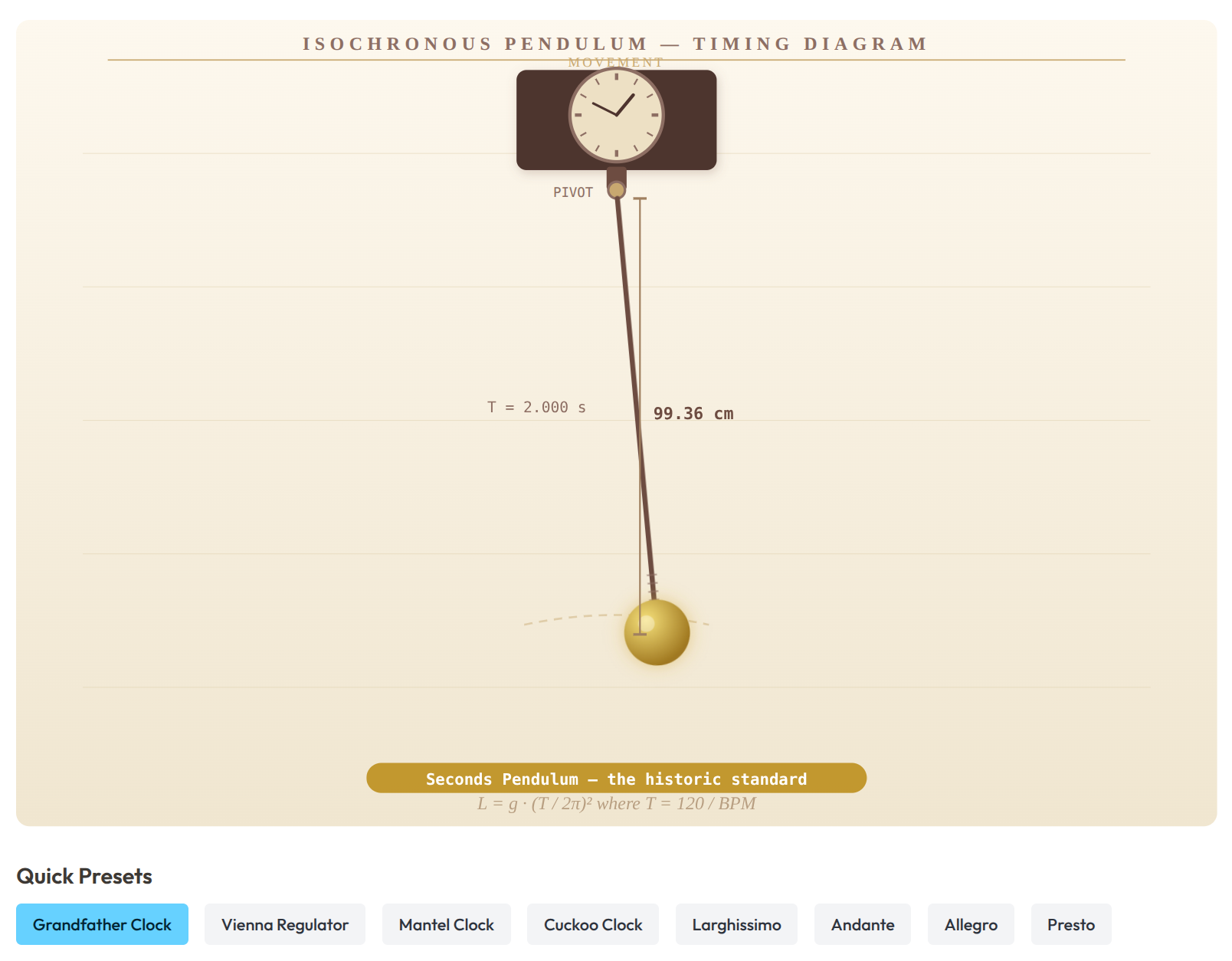
The equation Galileo began working out in the 1580s, and Huygens formalised in 1656, is what the Pendulum Length Tuner at riatto.ovh runs on.
Inputs:
Target Tempo (BPM) — the desired beats per minute; 60 BPM gives you the classic seconds pendulum at ~99.4 cm
Local Gravity (g) — gravitational acceleration in m/s²; defaults to 9.80665 (standard) but you can adjust for your actual latitude and altitude, exactly as Richer would have needed to do in Cayenne
Display Unit — metric (cm) or imperial (inches)
Outputs:
Pivot-to-bob center distance — the exact length to cut or adjust your pendulum rod
Full oscillation period — in seconds
Frequency — in Hz
Visual diagram — a scale rendering of the pendulum at the calculated length
Presets for common applications:
Grandfather Clock — the slow, stately beat of a longcase clock
Vienna Regulator — the precision wall clock standard of the 19th century
Mantel Clock — shorter pendulum, faster beat, designed for a domestic shelf
Cuckoo Clock — the rapid tick of a Black Forest mechanism
Larghissimo, Andante, Allegro, Presto — musical tempos for pendulum metronomes
The local gravity field is where Richer’s discovery lives, quietly, in the interface. If you are building or calibrating a clock at altitude or near the equator, you need a slightly different pendulum length than someone building the same clock at sea level in northern Europe. The tool accounts for this directly.
→ Browse pendulum clocks and horology books on Amazon
Affiliate disclosure: This post contains Amazon affiliate links. I may earn a small commission at no extra cost to you.
Timekeeping, Measured 🕰️
The pendulum belongs to the same tradition as the sundial and the zoetrope — devices that extracted precision from physics before electronics existed to do it automatically.
The Sundial Gnomon Calculator (covered in The Stick That Measured the Earth) worked by casting shadows at known angles — turning geometry into time. The Zoetrope Strobe Tuner (covered in The Cardboard Drum That Invented Cinema) worked by dividing time into precise intervals to create the illusion of motion. The pendulum clock works by counting the rhythm that gravity imposes on a swinging weight.
All three are, at root, the same act: reading time from the physical world.
The difference is that the pendulum clock didn’t just read time — it imposed it. Once accurate clocks were cheap enough to be everywhere, time became something that could be synchronised. That synchronisation, spreading outward from observatories and church towers and eventually railways, is the infrastructure of modern coordinated life. 🎯
Wrapping Up
Galileo’s cathedral observation was, by his biographer’s account, an accident — a student killing time between lectures, watching a lamp drift back and forth. The fact that his pulse gave him a measuring instrument was lucky. The fact that he noticed the count didn’t change was genius.
The equation he began assembling that day, and Huygens completed just fourteen years after Galileo’s death, is still in the tool. The seconds pendulum is still 99.4 cm. Gravity still varies by latitude, exactly as Richer measured in Cayenne in 1672. The physics hasn’t moved.
What has changed is that you can now enter your target BPM and your local gravity constant and get the exact pivot-to-bob distance for your pendulum in under a second — without a cathedral lamp, a heartbeat, or a ship to South America.
→ Try the Pendulum Length Tuner on riatto.ovh
References
Galileo, G. (1638). Discourses and Mathematical Demonstrations Relating to Two New Sciences. Elzevir, Leiden. (Public domain)
Huygens, C. (1658). Horologium. The Hague. (Public domain)
Wilkins, J. (1668). An Essay Towards a Real Character and a Philosophical Language. London. (Public domain)
Alder, K. (2002). The Measure of All Things: The Seven-Year Odyssey and Hidden Error That Transformed the World. Free Press, New York.
Débarbat, S. & Quinn, T. (2019). “The Metre: A Chronological Account of its Origins and Evolution.” Comptes Rendus Physique, 20(1–2), 55–64.
🐾 Feline Institute of Applied Pendulum Research & Involuntary Isochronism Studies
i discovered isochronism on my own. 😼
i was sitting on the clock. the pendulum was swinging. i batted it. it swung. i batted it harder. it swung the same. i batted it very hard indeed — full commitment, both paws, complete follow-through. it swung the same. 🐾
this is, apparently, a fundamental property of physics called isochronism and galileo spent years documenting it. i documented it in forty-five seconds. you’re welcome, science. 😤
the tool says the seconds pendulum is 99.4 cm long. this is correct. i have sat next to one and it is a very good height. when the bob swings past at the bottom of the arc, it is precisely at nose level. i have conducted extensive proximity trials. the bob does not stop for inspection purposes regardless of how many trials are conducted.
current status: positioned directly beside the grandfather clock. if the period changes, i will be the first to know. 🕰️😴
🐾 — Professor Oscillation, Director of Involuntary Isochronism Research, Feline Institute of Applied Pendulum Research
About this article
This post was written by AI and reviewed by the author. All factual claims were verified (with another prompt) at the time of publication. Final perspective, editorial judgement, and any opinions expressed are the author’s own.Published on riatto.substack.com · March 2026