
They Called It the Ordinary
Victorian cyclists didn’t call it a penny farthing. That name wasn’t printed until 1891 — after the machine had nearly vanished.

They called it the Ordinary, because to them it was perfectly normal to sit five feet in the air on a wheel with no gears, no brakes worth mentioning, and a tendency to throw you headfirst into the road.

✦ Transparency note: This article was written by AI and reviewed by the author. All factual claims were independently verified (at least with another prompt) before publication. Mistakes may still happen.
Disclaimer: The information in this post is for educational and informational purposes only. It does not constitute financial, legal, or professional advice. The author is not liable for any financial loss or damages arising from use of this information. Data, pricing, and availability referenced here may be out of date — always verify independently before acting on it.
The name “penny farthing” comes from two British coins. The penny was large. The farthing — worth one quarter of a penny — was small. Place them side by side and you have the proportions of the machine: one enormous wheel at the front, one tiny wheel trailing behind.
It is a perfect name. It is also a name that nobody used while these bicycles were actually being ridden.
The first recorded appearance in print of the phrase “penny-farthing” is from Bicycling News in 1891. By that point, the high-wheel bicycle had been largely superseded by the chain-driven safety bicycle. The men and women who had ridden these machines in their prime — who had raced them, climbed on them from running starts, and occasionally been launched over the handlebars at full speed — called them by a different name. 🚲
They called them Ordinaries. The most dramatic bicycle ever built was named, by the people who rode it every day, as though it were furniture.
The Gear That Wasn’t There 🔧
To understand the Ordinary, you have to understand a constraint that defined its entire existence: it had no gears.
Not no derailleur. Not no shifter. No gears at all — in the modern sense of any mechanical ratio between pedal and wheel. The pedals were bolted directly to the axle of the front wheel. One rotation of your legs produced exactly one rotation of the wheel. There was no chain, no cassette, no multiplication of effort. The physics were as simple as physics gets: you pedal once, the wheel turns once, and you travel a distance equal to the wheel’s circumference.
The only variable was the wheel’s diameter.
A 36-inch wheel travels about 113 inches per revolution. A 52-inch wheel — the most common size for an adult male rider — travels about 163 inches. A 60-inch racing wheel covers nearly 188 inches per revolution.
Every extra inch of wheel diameter was, in effect, a higher gear. 😮
This is why the wheels grew. It was not vanity or fashion or Victorian excess. It was pure physics. If you wanted to go faster — if you wanted to cover more ground per pedal stroke, to race, to keep pace with a horse on an open road — you needed a bigger wheel. The engineering optimum and the speed record both pointed in exactly the same direction: upward.
The riders followed.
Starley and the Ariel 🔩
The machine that crystallised this logic into a commercial product was the Ariel, produced by James Starley and William Hillman in 1871. Patent 2236, filed 11 August 1870, claimed “improvements to wheels and driving gear” — what they actually produced was the first successful all-metal bicycle with wire-spoked tension wheels.
Before the Ariel, bicycle frames were wooden and heavy. The French vélocipède — the boneshaker — had wooden wheels with iron tyres and a bone-jarring ride over cobblestones. Starley’s wire-spoke wheel was drawn tight under tension, like a harp string, and the result was a wheel that was simultaneously lighter, stronger, and more responsive than anything previously built.
Starley was a sewing-machine engineer from Coventry who had never intended to be a bicycle manufacturer. He had, however, a precise and practical mind: when he saw a problem, he solved it with geometry. The spoke tension wheel was a geometry problem. So was the question of how large to make the front wheel. The answer was: as large as the rider’s leg inseam could manage. 🎯
Starley would eventually be called the father of the bicycle industry. He didn’t live to see his invention’s successor — he died in 1881, four years before his nephew John Kemp Starley launched the Rover safety bicycle. But for a decade, his Ordinary defined what a bicycle was.
The Name Was Earned 💨
By the mid-1870s, cycling clubs were forming across Britain. The Bicycle Touring Club (later the Cyclists’ Touring Club) was founded in 1878. Races were organised. Manufacturers competed to offer the most favourable wheel sizes for competitive riding.
A 52-inch wheel at 60 RPM — a relaxed touring cadence — covered roughly 14.5 mph. A racing rider on a 60-inch wheel at 90 RPM could sustain speeds that drew crowds to city streets to watch. The combination of mechanical simplicity and real speed made the Ordinary genuinely thrilling to ride — when it wasn’t trying to kill you.
The killing part was called a header.
Any sudden obstacle — a stone, a rut, a dog — could stop the front wheel dead while the rider’s momentum continued forward. Because the rider sat almost directly above the front axle, there was very little mechanical warning before the front wheel locked and the body followed the only path available: over the handlebars, headfirst, from a height of four to five feet.
Experienced riders developed a technique for descending hills: they would swing both legs forward over the handlebars, resting their feet on special footrests mounted on the fork. This looked extremely peculiar. It made excellent sense. If the front wheel caught at 20 mph going downhill, the rider went forward feet-first rather than head-first. The injury calculus was clearly preferable. ☁️
Handlebar designs evolved specifically to allow the rider’s knees to clear in a header. Protective gear was discussed in cycling magazines with the seriousness of engineering correspondence. The Ordinary was fast, elegant, and well-understood — and everyone who rode it understood that it required your full attention, all the time.
The Safety Bicycle Ends It All ✂️
In 1885, John Kemp Starley — nephew of the Ariel’s inventor — launched the Rover safety bicycle. It had two wheels of equal size, a diamond frame, and a chain drive connecting pedal to rear wheel. The chain drive introduced a mechanical ratio between legs and wheel: you could now gear the bicycle without changing wheel size.
In 1888, John Boyd Dunlop developed and patented a practical pneumatic tyre. The Ordinary had survived partly because its large wheel provided a smoother ride than smaller wheels on rough surfaces — it simply rolled over obstacles more easily. The pneumatic tyre gave small wheels the same absorption. The last argument for a giant front wheel evaporated.
The Ordinary was commercially dead within a few years.
The safety bicycle’s descendants — the chain-drive, same-sized-wheel, multiple-gear machine you ride today — have exactly the same lineage as the Rover. The Ordinary contributed something else: it proved that cycling was viable, popular, and worth engineering seriously. It created the market that the safety bicycle inherited. 🎯
And then, safely superseded, it received its nickname. Penny farthing. 1891. By then, the riders had moved on.
The High-Wheeler Gear Calculator 📐
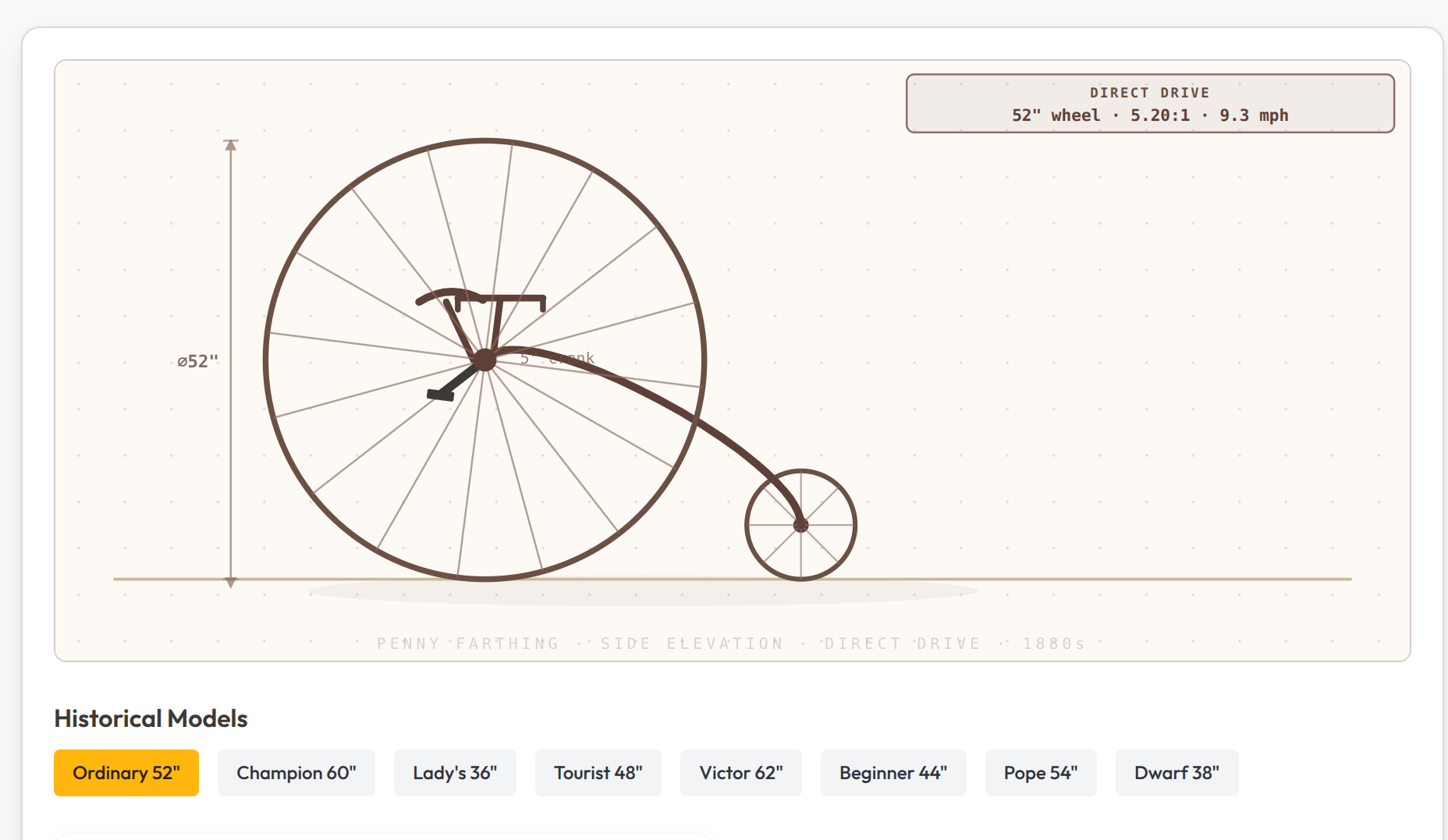
The High-Wheeler Gear Calculator at riatto.ovh models the direct-drive physics of an Ordinary precisely. Enter your wheel diameter, crank length, and cadence, and it returns the numbers every Victorian racing cyclist would have known by instinct.
Inputs:
Front Wheel Diameter (inches) — the historical range was 36 to 62 inches; 48 to 54 inches was standard for adult male riders
Crank Arm Length (inches) — the historical standard was 5 inches; ladies’ models used 4-inch cranks
Pedalling Cadence (RPM) — 55 to 65 RPM for touring; racing sprints reached 90 RPM and above
Outputs:
Gear Inches — the effective gear size; on a direct-drive machine, this equals the wheel diameter
Gain Ratio — wheel radius divided by crank length; a formula popularised by cycling writer Sheldon Brown that expresses mechanical advantage in a dimensionless form usable across any wheel size or measurement system
Speed (mph) — calculated as gear inches × cadence ÷ 336
Distance per Revolution — the circumference your wheel covers in each full pedal stroke
Quick Presets (exact historical models):
Ordinary 52” — the most common adult male configuration; solid all-round touring machine
Champion 60” — high-performance racing wheel; dramatically more speed, dramatically less forgiveness
Lady’s 36” — smaller wheel, 4-inch crank, designed for the then-fashionable side-saddle mounting position
Tourist 48” — a practical mid-size machine favoured for longer road journeys
Victor 62” — the maximum practical wheel diameter; reserved for serious competitive riders
Beginner 44” — a sensible first machine; lower seat height, lower centre of gravity
Pope 54” — the signature model of the Pope Manufacturing Company, the dominant American producer
Dwarf 38” — a transitional design, smaller-wheeled, bridging toward the safety bicycle
The tool also includes a Historical Reference Table drawing on Bicycling News and The Cyclist (Victorian-era cycling publications, now public domain) — eight documented models from the 1878–1888 period, each with wheel diameter, crank length, gear inches, and recorded speed at 60 RPM.
→ Browse penny farthing and Victorian cycling history books on Amazon
Affiliate disclosure: This post contains Amazon affiliate links. I may earn a small commission at no extra cost to you.
The Number Inside the Wheel 🔢
The gear inches formula on a direct-drive machine is almost insultingly simple:
Gear inches = wheel diameter.
That’s it. A 52-inch wheel gives you 52 gear inches. A 60-inch wheel gives you 60. No chain ratio, no multiplication factor. The wheel IS the gear.
What makes this worth pausing over is how elegantly this exposes the fundamental constraint. Modern cyclists express gear ratios in terms of chainring teeth, cassette teeth, and wheel size — three variables interacting. On an Ordinary, the entire equation collapses to one number. The designer has exactly one degree of freedom: wheel diameter.
The gain ratio is more nuanced. A 52-inch wheel (26-inch radius) with a 5-inch crank gives a gain ratio of 5.2 — meaning each centimetre of foot travel produces 5.2 cm of forward progress at the wheel rim. A modern fixed-gear track bike running a 100 gear-inch setup has a gain ratio of roughly 7 to 8. The Ordinary was not as mechanically extreme as it looks.
What made it dangerous was not the gear ratio. It was the geometry: rider directly above the front axle, at height, with no real braking authority and no suspension. A gain ratio of 5.2 can be found on perfectly safe modern bicycles. What cannot be reproduced safely is the seating position. 😮
The formula survived. The seating position did not.
Victorian Engineering, Revisited 🎯
The Ordinary belongs to the same era and the same engineering culture as the box kite — a decade of empirical refinement arriving at a number that is simple, correct, and still useful today. Hargrave’s 50% gap rule (covered in The Gap That Changed Everything on this Substack) and Starley’s wire-spoke tension wheel both represent the same approach: take a physical constraint, model it precisely, arrive at a ratio, and build to that ratio.
Both were superseded — the Ordinary by the safety bicycle, the box kite by the weather balloon. Both left their ratios behind, still working, still calculable, still worth understanding.
Wrapping Up 🚲
The Ordinary was the fastest human-powered land vehicle of the 1870s and 1880s. It was fast enough to race, fast enough to tour across counties, fast enough to require riders to devise strategies for not dying on descents. It was called the Ordinary because the people who rode it had normalised all of this.
The name “penny farthing” arrived in print in 1891, in Bicycling News, after the machine it named had been largely replaced. It is a retrospective nickname — affectionate, perfectly descriptive, and given to something that no longer needed a nickname because it was already history.
The physics it ran on — wheel diameter equals gear inches, speed equals gear inches times cadence divided by 336 — are still exact. The High-Wheeler Gear Calculator computes them for any combination of wheel and crank you can imagine, from the modest Lady’s 36” to the fearsome Victor 62”.
You don’t need to ride one. You just need to know what the numbers meant to the people who did.
→ Try the High-Wheeler Gear Calculator on riatto.ovh
Very English. And away he goes…
References
Penny-farthing — Wikipedia: en.wikipedia.org/wiki/Penny-farthing
James Starley — Wikipedia: en.wikipedia.org/wiki/James_Starley
Patent 2236, 11 August 1870 — Starley & Hillman, “improvements to wheels and driving gear.” UK Patent Office. (Public domain)
Bicycling News (1878–1895) and The Cyclist (1879–1892) — Victorian cycling trade publications. (Public domain)
Rover safety bicycle (1885) — John Kemp Starley. Reference: History of the Bicycle, Wikipedia: en.wikipedia.org/wiki/History_of_the_bicycle
🐾 Feline Institute of Velocity Miscalculation & Unplanned Aerial Dismount Studies
i have reviewed the high-wheeler gear calculator. i have also reviewed the concept of sitting directly above a moving wheel with no braking mechanism and i have several concerns. 😼
cats do not do headers. this is a deliberate evolutionary choice. when i misjudge a leap — which is rare, essentially never, do not check the bookshelf — i land on four paws and walk away with dignity. the victorian cyclist had no equivalent system. they had mustache handlebars and optimism.
the gain ratio on the champion 60” preset is 6.0. i achieve a comparable ratio simply by extending my full body length from the kitchen counter. my dismount protocol involves sitting down immediately afterward and licking one paw, which signals to observers that the outcome was intentional. 🎯
i note that the lady’s 36” preset uses a 4-inch crank. this is a sensible concession to biomechanics. i also operate with a shorter stride than advertised. we do not discuss this.
the formula is: gear inches × cadence ÷ 336 = mph. my formula is: distance to treat bag ÷ number of humans in the room × current motivation level = whether i bother. both are correct. 😹
the tool has a “stability rating.” i do not require a stability rating. i have four contact points and a low centre of gravity. the victorian cyclist had two wheels, one of them enormous, and what appears to have been extraordinary confidence.
i respect the confidence. i do not endorse the geometry.
🐾 — Chief Inspector Tumble, Feline Institute of Velocity Miscalculation & Unplanned Aerial Dismount Studies
About this article
This post was written by AI and reviewed by the author. All factual claims were verified (with another prompt) at the time of publication. Final perspective, editorial judgement, and any opinions expressed are the author’s own.Published on riatto.substack.com · March 2026