
Your Kitchen Is Not the Same Kitchen Twice
In 1886, a Victorian chemist named William Jago worked out why sourdough behaves differently every time. The instruction everyone gives you — “let it rise until doubled” — is still ignoring him.

✦ Transparency note: This article was written by AI and reviewed by the author. All factual claims were independently verified (at least with another prompt) before publication. Mistakes may still happen.
Disclaimer: The information in this post is for educational and informational purposes only. It does not constitute financial, legal, or professional advice. The author is not liable for any financial loss or damages arising from use of this information. Data, pricing, and availability referenced here may be out of date — always verify independently before acting on it.
Here is the instruction that appears in almost every sourdough recipe:
“Let it rise until doubled in size.”
It sounds like precision. It looks like precision. It is, in practice, almost useless — and a Victorian chemist could have told you exactly why 140 years ago. 🍞
Two bakers can follow this instruction in the same city on the same day and end up with doughs that need 4 hours and 9 hours respectively — both technically correct, both “doubled,” arriving at completely different points in the fermentation curve. 😮
The variable they’re not measuring is temperature. And temperature, as William Jago established in 1886, runs everything.
The Victorian Chemist at the Bakery 🏭
In 1886, an English food chemist named William Jago published The Chemistry of Wheat, Flour, and Bread, and Technology of Breadmaking — a systematic, scientifically rigorous account of what actually happens inside a fermenting dough.
Jago was working at a moment when bread manufacture was transitioning from craft to industry. The Victorian era had produced massive urban populations who needed reliable, consistent bread at scale. Bakers who had spent generations reading dough by intuition — poking, prodding, watching — were being replaced by factory processes that needed to produce the same result every day, regardless of season or weather.
The problem was that bread doesn’t behave the same every day. Fermentation is alive. It responds to its environment. Jago’s task was to bring the same quantitative rigour that had transformed chemistry in the early 19th century to the baker’s table.
His central finding was uncomfortable for anyone who wanted simple, repeatable instructions: yeast activity is not linear, and it is not fixed. It is profoundly, measurably temperature-dependent. The rate of fermentation changes meaningfully even across 5°F (about 3°C). A dough that needs 4 hours to complete bulk fermentation at 75°F may need 9 hours at 65°F — the same starter, the same flour, the same hydration. Only the room temperature changed. 🌡️
“Let it rise until doubled” was, from a scientific standpoint, an instruction with its most important variable missing. Jago knew this. The home-baking world is still catching up.
Why Temperature Is the Ingredient Nobody Lists 🌡️
Yeast operates through enzymatic reactions. Like all chemical reactions, those reactions accelerate in warmer conditions and slow in cooler ones.
At 65°F (18°C): fermentation is sluggish. Bulk fermentation may take 10–14 hours or more.
At 75°F (24°C): the comfortable middle ground for most sourdough. Bulk fermentation in the 5–8 hour range.
At 80°F (27°C): fermentation is moving quickly. Bulk may complete in 4–6 hours.
At 85°F (29°C): yeast is highly active — and the window for catching the dough at its peak before overproofing begins to narrow dangerously. ⚠️
(Ranges assume a standard 15–20% starter at full activity. Higher starter percentages or wetter doughs will ferment faster.)
A 10°F swing — entirely possible between a cool morning kitchen and a warm afternoon kitchen in the same house — can halve or double your fermentation time.
This is why professional bakers obsess over room temperature. It’s not precious. It’s because the instruction “4 hours bulk fermentation” is only accurate for the exact temperature at which it was tested. Your kitchen at 68°F in January is not the same kitchen as your kitchen at 78°F in August. Jago’s point, translated to the 21st century: temperature is an ingredient, and it needs to go in the recipe. 🔢
The Sourness Secret Most Home Bakers Miss 🍋
Here is a piece of sourdough science that almost no home recipe explains:
Sourness does not come primarily from bulk fermentation. It comes from cold fermentation.
A sourdough starter contains acid-producing bacteria (collectively called lactic acid bacteria, or LAB) alongside the yeast. These bacteria produce two key acids — and the ratio between them changes with temperature. 😮
Lactic acid — milder, yogurt-like sourness. Produced in higher proportion at warmer temperatures.
Acetic acid — sharper, more vinegary sourness. Produced in higher proportion at cooler temperatures. Acetic acid is said to flourish around 50°F — the range of a typical refrigerator.
During bulk fermentation at room temperature, lactic acid dominates — you get mild sourness, open crumb structure, good rise. This is what makes the bread taste like bread rather than cardboard.
During cold fermentation — the retard in the refrigerator, typically 8 to 72 hours — the bacteria shift their metabolic output. Cooler temperatures suppress lactic acid production while acetic acid continues to accumulate, slowly building the sharp, complex sourness that distinguishes a genuinely sour sourdough from a mild one.
Mild sourness? Short cold retard. Strong sourness? Long cold retard.
This means two bakers using exactly the same recipe, flour, and starter can produce dramatically different-tasting bread simply by varying how long the shaped loaf spends in the refrigerator. Most home recipes don’t expose this lever at all — they prescribe “overnight” as if it’s a fixed step, not a dial you can turn. 🎚️
The Language of Professional Bakers: Baker’s Percentage 📐
If you’ve looked at a professional bakery formula and felt faintly confused by the proportions, it’s because professionals don’t write recipes the way home cooks do.
Home recipes list amounts in grams or cups. Professional bakers use baker’s percentages — a ratio system where flour is always 100%, and every other ingredient is expressed as a percentage of the flour weight.
It scales perfectly. A formula in baker’s percentages works for 500g of flour or 50kg — same ratios, no conversion arithmetic. And it communicates the character of the bread immediately: high hydration means an open, lacy crumb; low salt percentage means flat flavour; high starter percentage means faster fermentation with milder taste.
The standard reference points for sourdough:
Hydration: 70–80% for most sourdough loaves; higher for ciabatta and focaccia
Salt: 2% — enough for flavour and crust development without inhibiting yeast
Starter: 10–20% of flour weight for typical timing; lower for a longer, more flavourful ferment 📊
Once you understand this language, you can read any professional formula and immediately understand what kind of bread it will produce. The Sourdough Alchemist teaches it by default: every session shows you your own ingredients expressed in baker’s percentages, alongside the grams.
A Southeast Asian Twist: Chinese Pau 🥟
One of the most interesting entries in the Sourdough Alchemist’s bread type selector is Chinese Pau — the steamed bun.
Conventional Pau (包) uses commercial yeast or baking powder, producing a soft, pillowy bun with a fine, even crumb and virtually no tang. Sourdough Pau is rarer — a variation that uses wild fermentation to develop a subtle complexity that commercial yeast can’t produce. The steam-cooking method (rather than dry oven heat) creates a uniquely soft, moist exterior without any crust. 🌏
Wild fermentation has deep roots in East and Southeast Asian food culture — in fermented bean pastes, rice wines, vinegars, and preserved vegetables — but wild-leavened bread in the Western sourdough sense is a more recent convergence. Using a sourdough starter in a Pau dough is a small, interesting meeting point between European fermentation science and a culinary tradition that has been fermenting things in its own ways for millennia.
The tool assigns Pau its own default hydration and calibrated fermentation multipliers — different from a baked sourdough loaf, because the texture target is entirely different. The bulk fermentation timing changes; the cold fermentation window adjusts. Same starter, same underlying science, different bread entirely. 😮
The Tool: Sourdough Alchemist 🧪
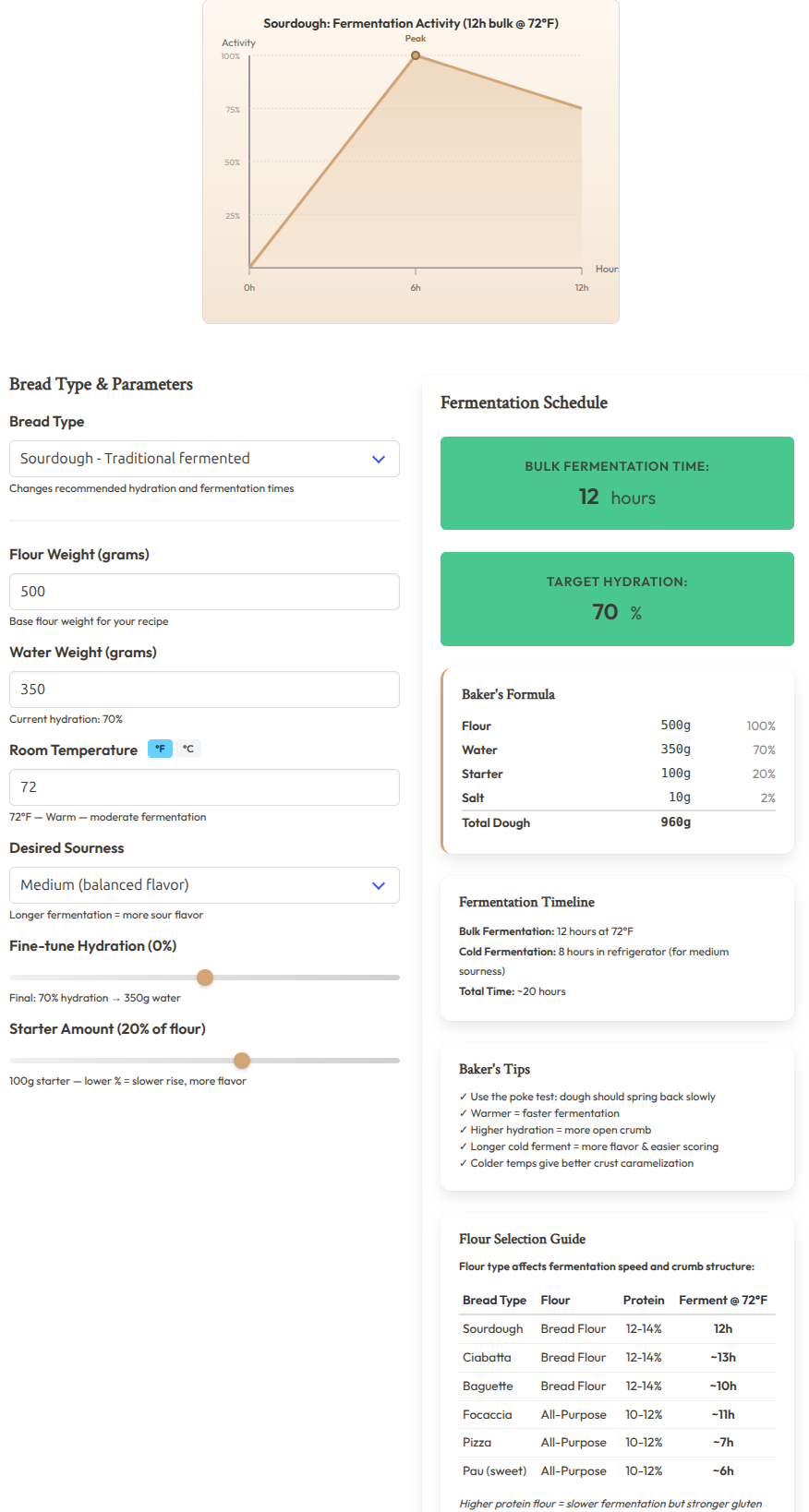
This is Jago’s insight made interactive: fermentation is temperature-dependent and therefore calculable. Your actual kitchen conditions today, producing your actual bake schedule tonight.
Inputs
Bread type — 6 presets with calibrated defaults: Sourdough, Baguette, Ciabatta, Focaccia, Pizza, Chinese Pau 🥖
Flour weight (grams) — your base; everything scales from here
Water weight (grams) — auto-calculates hydration percentage
Room temperature — with °F/°C toggle; the critical variable most recipes omit 🌡️
Desired sourness — Mild / Medium / Strong — controls cold fermentation duration directly
Hydration fine-tune slider — ±15% live adjustment
Starter amount slider — 5–30% of flour weight
Outputs — Baker’s Formula
Ingredient Grams % Flour user input 100% Water calculated hydration %Starter calculated user-set % Salt calculated 2% Total dough sum—
Fermentation Schedule
Bulk fermentation time — temperature-driven and bread-type adjusted
Cold fermentation time — sourness-driven
Total time from mix to bake
SVG Fermentation Activity Curve 📊
A live bell curve showing yeast activity across the bulk fermentation window. A peak marker identifies the optimal fold and shaping moment. The curve adjusts its shape based on hydration — high-hydration doughs peak faster and have a narrower optimal window. This is the visual equivalent of what professional bakers read by touch.
Reference Content built in: Baker’s Tips (poke test, temperature sensitivity, crumb guidance), Flour Selection Guide (protein % and fermentation time by bread type), and Lab Notes covering the Jago 1886 historical context.
Using the Tool in Practice 🎯
For first-time sourdough bakers: Select the Sourdough preset. Enter your flour weight, set your actual room temperature, choose Mild sourness. Read the bulk fermentation time — that is when your dough should be ready to shape. Not when it “looks doubled.” Follow the schedule, check with the poke test at the window it gives you. 🍞
For experienced bakers troubleshooting sourness: If your bread isn’t tangy enough, the instinct is to change the flour or the starter. The tool suggests looking at cold fermentation first. Move from Medium to Strong and extend the refrigerator time — that’s where acetic acid develops. It’s the cheapest lever you have and the least obvious one. 🔧
For bakers scaling recipes: Baker’s percentage output makes scaling trivial. Double the flour, all other quantities scale proportionally. Fermentation times stay the same — they depend on temperature, not batch size. ↕️
For pizza and focaccia: These have their own hydration defaults and fermentation multipliers. Pizza dough at 62–65% hydration with a shorter bulk fermentation is a completely different animal from an 80% open-crumb sourdough. The tool tracks this per bread type rather than applying sourdough logic to everything. 🍕
Step-by-Step: Your First Calculated Bake 📋
Step 1 — Set bread type and flour weight 🥖
Open the Sourdough Alchemist and select your bread type. If you’re new to sourdough, start with Sourdough. Enter your flour weight. The tool pre-fills water at the default hydration for that bread type — review the hydration percentage: 70–80% is the standard range for a sourdough loaf.
Step 2 — Enter your actual room temperature 🌡️
This is the step most home recipes skip, and it’s the one that makes the fermentation output accurate. Check a thermometer — not your guess, your actual kitchen temperature. If you don’t own a kitchen thermometer, this is the moment. Everything downstream depends on this number.
Step 3 — Choose your sourness 🍋
Mild for a young, versatile loaf. Medium for a classic sourdough tang. Strong for the sharp, complex acidity of a long cold retard. This choice directly sets your cold fermentation window. You now understand why: short cold fermentation = lactic acid dominance = mild. Long cold fermentation = acetic acid builds = more sour.
Step 4 — Read your Baker’s Formula 📊
The table shows your complete recipe in both grams and percentages. Write it down. Notice the salt at 2% and the starter at your chosen percentage — that’s the professional ratio system, expressed in your actual quantities. This is also your scaling foundation for future bakes.
Step 5 — Follow the fermentation schedule ⏱️
Set a timer for the end of the bulk fermentation window. At that point, conduct the poke test: gently press the dough with a floured finger. A slow spring-back in 2–3 seconds = ready to shape. Immediate spring-back = underproofed. No spring at all = overproofed. The poke test is Jago’s theory expressed in your fingertip.
Step 6 — Watch the fermentation curve 📈
The SVG bell curve shows yeast activity across your bulk window. The peak marker is your ideal shaping moment — after peak activity begins, before decline sets in. For high-hydration doughs, this window is narrower; don’t let the dough go past the peak without shaping or refrigerating. The poke test and the curve are telling you the same thing from different directions. 😌
🐾 A Field Report from the Department of Dough Surveillance & Unsolicited Quality Control
Institute of Applied Kitchen Thermodynamics · Riatto Lab
mrrp. 🐱
i positioned myself beside the oven at 06:47. the oven radiates warmth from its lower vents. this placement was for research purposes. i was not simply sitting near the oven because it is warm. this is a subtle but important distinction that the human continues to get wrong. 🌡️
the human was preparing a starter jar. the jar smelled wrong. specifically, it smelled like something that had been forgotten and then decided to become an event. i investigated from a safe professional distance of approximately twelve centimetres. 😾
the human said the starter was “active.” i took note of this descriptor. it was, in fact, moving. this is consistent with the definition of active. i have no further notes on this observation.
i then watched the human consult a recipe. the recipe said: “let it rise until doubled.”
i stared at the bowl for forty-three minutes. it did not double. 👁️👁️ the human returned at minute forty-three and appeared satisfied by something i could not perceive. we exchanged a long look.
i have since reviewed the literature. “let it rise until doubled” is a conditional statement with a missing condition. the missing condition is: at what temperature? i know about temperatures. i maintain my own temperature classification system (too cold, acceptable, optimal, oven vent adjacent) and i adjust my location accordingly with considerable scientific discipline.
the human now uses the sourdough alchemist. they enter the room temperature. they read the schedule. the bread comes out at the same time two days in a row. i consider this an improvement but reserve final judgment. 😌
i conducted my own poke test. 🐾 i applied one paw to the proofed dough at a moment that seemed appropriate to my methodology. the human said i had “contaminated the experiment.” i said nothing. we do not explain our methodology to reviewers.
the resulting loaf had an open, irregular crumb. i consider this a collaborative outcome.
i also reviewed the chinese pau option. a steamed bun, wild-fermented. warm, soft, moist exterior. no crust to contend with. my assessment is: promising. i have applied for a research position near the steamer. 😸
— Crumb
Chief Quality Officer, Department of Dough Surveillance & Unsolicited Quality Control
Institute of Applied Kitchen Thermodynamics
“the dough is ready when i say it is ready.” 🐾
Try It
→ Sourdough Alchemist — riatto.ovh
Free to use. No sign-up required. 6 bread types, temperature-adjusted fermentation schedule, baker’s percentage formula, SVG fermentation curve, and direct sourness control.
Made a loaf using the calculator? Tell us the bread type, your room temperature, and whether the sourness setting matched what came out of the oven — drop it in the comments. 👇
→ Sourdough Baking Books on Amazon
Affiliate disclosure: This post contains Amazon affiliate links. I may earn a small commission at no extra cost to you.
References
William Jago (1854–1938), The Chemistry of Wheat, Flour, and Bread, and Technology of Breadmaking (1886), Brighton — Internet Archive: full text (public domain); Library of Congress record; Nature review of the 1886 edition
Temperature and sourdough bulk fermentation timing — The Sourdough Journey: The ULTIMATE Sourdough Bulk Fermentation Guide
Lactic acid vs acetic acid in sourdough; cold fermentation and sourness — King Arthur Baking: How to make your sourdough bread more (or less) sour
Baker’s percentage — King Arthur Baking: What Is Baker’s Percentage?
Chinese Pau (包) and steamed bun tradition — Wikipedia: Baozi (public domain)
Riatto Lab: Sourdough Alchemist
About this article
This post was written by AI and reviewed by the author. All factual claims were verified (with another prompt) at the time of publication. Final perspective, editorial judgement, and any opinions expressed are the author’s own.Published on riatto.substack.com · March 2026