
Every Brewing Method Is the Same Experiment
In 1952, researchers set out to define what made coffee taste good — using lab equipment, not taste tests.

The extraction window they identified is still the target every brewing method is designed around. A free tool now handles the ratio maths for all eight.
✦ Transparency note: This article was written by AI and reviewed by the author. All factual claims were independently verified (with another prompt) before publication. Mistakes may still happen.
Disclaimer: The information in this post is for educational and informational purposes only. It does not constitute financial, legal, or professional advice. The author is not liable for any financial loss or damages arising from use of this information. Data, pricing, and availability referenced here may be out of date — always verify independently before acting on it.
The Lab That Studied the Cup ☕
In 1952, the Coffee Brewing Institute — a research body funded by the Pan-American Coffee Bureau — commissioned a scientific study with a deceptively simple question: what actually makes a cup of coffee taste good? 😮
Not “what do people prefer.” What is actually happening, chemically, when coffee tastes right?
The researcher most associated with the answer was Ernest Earl Lockhart, working at MIT. His team used refractometers — instruments that measure how much light bends through a liquid, which indicates the concentration of dissolved solids — to analyse brewed coffee and correlate the chemistry with taster preferences. After extensive testing, they identified a target zone: when 18 to 22 percent of the dry coffee’s mass dissolves into the water, the resulting cup scores highest for flavor.
Below that range: under-extraction. The brew is sour, thin, and grassy — the pleasant compounds haven’t been reached yet. Above it: over-extraction. The brew turns bitter and harsh, as the water pulls out astringent and unpleasant compounds that should have stayed in the grounds.
That finding — the 18–22% extraction yield — was later formalised by the Specialty Coffee Association as the Gold Cup Standard. It is still the benchmark that specialty coffee professionals use today. 🎯
The remarkable thing is what it implies: every brewing method ever invented — Turkish ibrik, Moka pot, French press, Chemex, AeroPress, espresso — is just a different mechanical approach to the same underlying target. The equipment changes. The grind size changes. The temperature, the time, the pressure all change. But the extraction window never moves.
The Window, and What Happens Outside It 🔬
Here is the key insight the Gold Cup research established.
Coffee grounds contain hundreds of compounds — acids, sugars, lipids, volatile aromatics, bitter alkaloids, astringent phenols — dissolved in layers, in roughly that order. The pleasant ones — the fruity acids, the caramelised sugars, the floral aromatics — come out first. The unpleasant ones come out last.
Extraction yield measures how far you’ve gone through that sequence. At 18–22%, you’ve captured most of the good compounds and stopped before the harsh ones dominate. That window is not arbitrary — it reflects the actual chemistry of what comes out of the bean at what point in the brewing process.
The ratio — coffee to water — is the practical shorthand for hitting that window without a refractometer. If you use 20 g of coffee to 320 g of water (a 1:16 ratio), and your grind, temperature, and brew time are calibrated for the method, you will land inside the extraction window. If you use significantly more water (say, 1:20), the water pulls further than it should, over-extracting. If you use much less (say, 1:10), the water becomes saturated before full extraction and you under-extract. 🎯
The ratio is not a preference. It is a proxy for physics. 😮
Eight Methods, Eight Machines, One Target 🛠️
Every brewing method in history is essentially a different solution to the same engineering problem: how do you move water through coffee grounds in a way that hits the extraction window, given the constraints of available equipment and time?
The results are strikingly varied:
Turkish coffee is one of the oldest brewing methods still in widespread use — documented in Ottoman coffeehouses from the 1500s in Constantinople. The grounds are never filtered out; they settle. The ratio is tight (1:9), the grind is powder-fine, and the brew time is long enough to fully extract at near-boiling temperature. It is the simplest method and the least forgiving of ratio errors. ☕
Espresso arrived when Angelo Moriondo of Turin, and later Luigi Bezzera, developed machines that forced pressurised steam and hot water through tightly packed fine-ground coffee — Bezzera’s patent dates to 1901. The result was a 1:2 ratio in roughly 25–30 seconds. The concentrated result — syrupy, intense, with a crema of emulsified coffee oils — was entirely new. Espresso is not “strong coffee” in the traditional sense; it is coffee brewed at high pressure, which changes which compounds are extracted and how they present in the cup.
The Moka pot brought espresso-adjacent pressure brewing into the home. Alfonso Bialetti introduced the octagonal stovetop pot in 1933 — a design so successful it has been in continuous production for nearly a century. It produces a 1:7 ratio, bold and strong, using steam pressure rather than pump pressure.
The Chemex is the inventor’s favorite. Peter Schlumbohm was a German-American chemist with over 300 patents. In 1941, he applied laboratory glassware principles — specifically the shape of the Erlenmeyer flask — to coffee brewing. The Chemex uses a thick, bonded paper filter and a 1:15 ratio; the filter removes more oils than a metal filter, producing a uniquely clean, bright cup. Schlumbohm’s patent emphasised the separation of grounds from brew and the control of flow rate — the concerns of a working chemist, not a barista. The Museum of Modern Art acquired the Chemex for its permanent collection in 1943.
The French press has been around longer than most people assume. An Italian designer named Attilio Calimani held an early patent from 1929, though the basic mechanism — immersion brewing with a plunger to separate the grounds — predates that. The 1:12 ratio and four-minute steep time produce a full-bodied, rich cup because the metal mesh filter lets oils and fine particles through. No paper barrier. The same compounds that the Chemex filters out are the ones that give French press coffee its characteristic body.
The AeroPress is the youngest method on the list. Alan Adler — an engineer, not a coffee professional — invented it in 2005 and sold it through his company, Aerobie, known for the flying ring toy. It combines immersion brewing with gentle air pressure and a very short brew time (1–2 minutes). The flexibility of the AeroPress is its defining feature: it tolerates a wide grind range, a wide temperature range, and almost any ratio in the 1:10–1:17 range, producing consistent results that more rigid methods won’t. It has developed one of the most dedicated user communities in specialty coffee.
Cold brew operates on a completely different extraction principle. Without heat, the rate of compound dissolution drops sharply — but given 12–24 hours of steeping at around 4°C, extraction proceeds slowly and selectively. Cold water favors lower-acid, sweeter compounds. The standard ratio (1:8, coarser) produces a concentrate that is typically diluted before drinking. The result — smooth, low-acid, naturally sweet — cannot be replicated by simply chilling hot coffee, which is a different product. ❄️
What the Roast Level Changes 🌡️
The tool’s roast adjustment is the feature that most brewing guides skip.
When coffee is roasted, the bean loses mass — moisture and carbon dioxide escape during the roast. A dark-roasted bean is more porous and physically lighter than a lightly roasted bean of the same origin. Dark roasts are more soluble: their structure breaks down during roasting, releasing compounds more readily on contact with hot water. Light roasts are denser and harder to extract; they require more attention to grind size, temperature, and contact time to coax out their more complex acids and aromatics.
In practice, most experienced brewers adjust for roast level primarily through grind and time — finer grind and longer steep for light roasts, coarser grind and shorter brew for dark — rather than changing the ratio. But the ratio still shifts because the style expectation shifts with it:
Light roast (1:15–1:17): The higher water ratio suits the lighter, more complex flavor profile that light roast drinkers are looking for — and compensates for the harder extraction with more water contact surface.
Medium roast: The method’s default ratio. The reference point that all brewing charts are built around.
Dark roast (1:10–1:14): Dark roast drinkers typically want a bold, concentrated, full-strength cup. The tighter ratio delivers that intensity. The easily-soluble dark roast extracts readily even at this concentration.
Extra dark roast (1:7–1:12): Strength is achieved primarily through concentration — most of the fruit and acid have been driven off during roasting. What remains is intensity, and the ratio reflects it.
The roast adjustment in the tool is partly science and partly style. Both matter. 🎯
What the Tool Does ⚙️
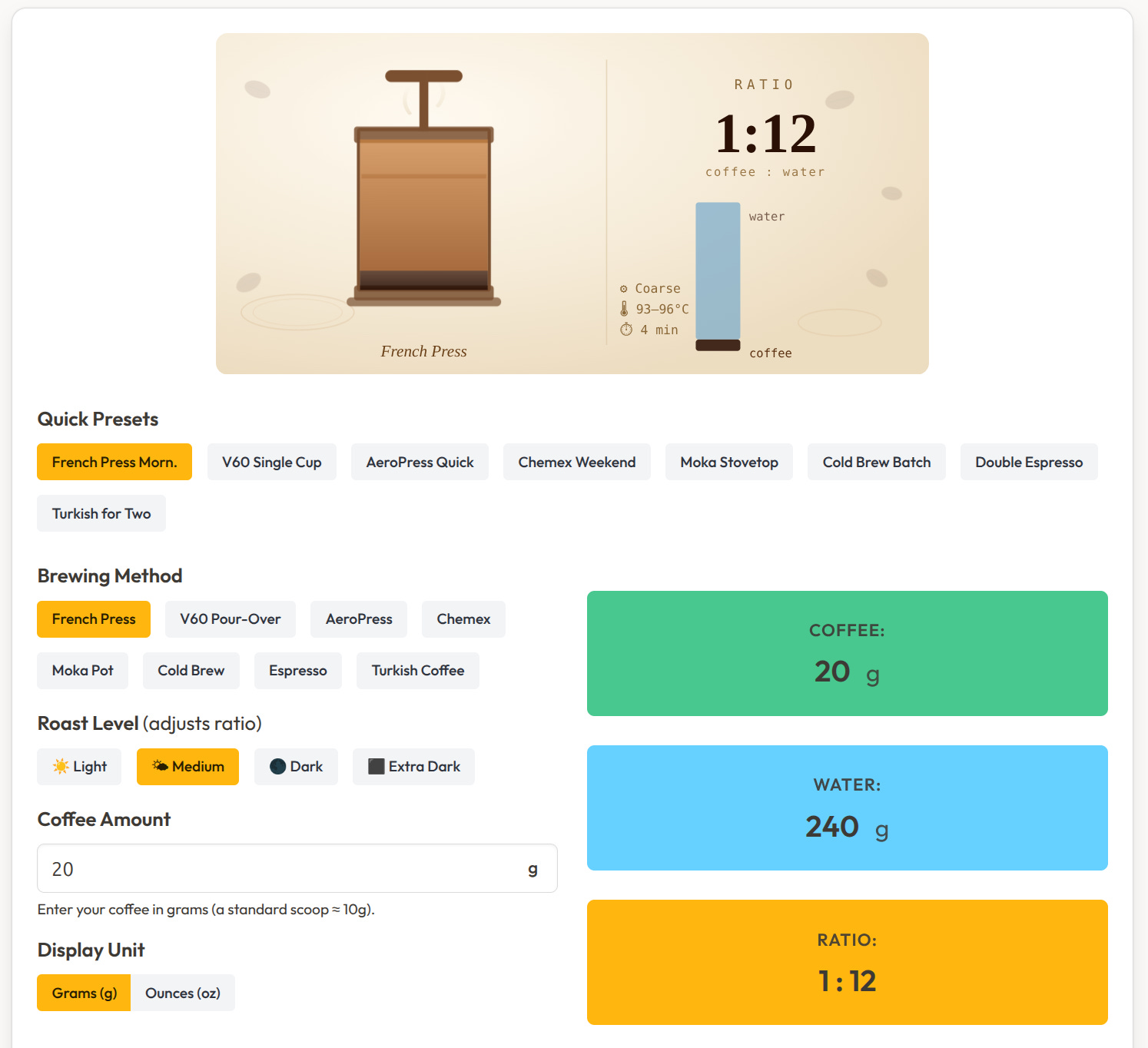
The Coffee Brew Ratio Calculator takes four inputs:
Brewing method — 8 options (Espresso, Moka Pot, Turkish, French Press, AeroPress, Chemex, V60 Pour-Over, Cold Brew)
Roast level — Light, Medium, Dark, Extra Dark
Coffee amount — grams (with a note that a standard scoop ≈ 10 g)
Display unit — grams or ounces
And returns six outputs for the selected method and roast combination:
Coffee amount (grams or ounces)
Water amount (grams)
Ratio (coffee : water format)
Approximate cups (volume in ml)
Brew temperature (Celsius range)
Brew time (minutes)
Flavor profile description — what the cup should actually taste like
The default French Press preset is a good starting reference: 20 g coffee, 240 g water, 1:12, approximately 1 cup (250 ml), 93–96°C, 4 minutes. Every number is derived from the Gold Cup framework and standard specialty coffee practice. 📐
Eight Presets, Eight Starting Points 🗺️
The tool’s quick-load presets each represent a distinct use case:
French Press Morning — the classic 1:12 immersion brew; full-bodied, rich, oils intact; beginner-friendly
V60 Single Cup — 1:16, pour-over, precise water control; the method that rewards technique the most
AeroPress Quick — 1:15, 1–2 minute brew; forgiving, consistent, excellent for travel or small batches
Chemex Weekend — 1:15, bonded paper filter, 4–5 minutes; bright, clean, and elegant; the scientist’s method
Moka Stovetop — 1:7, bold and strong, approximately 5–7 minutes; the espresso-adjacent home method
Cold Brew Batch — 1:8, extra coarse grind, 12–24 hours at 4°C; concentrate intended for dilution
Double Espresso — 1:2, 25–30 seconds, fine grind; intense and concentrated; starting point for espresso-based drinks
Turkish for Two — 1:9, powder-fine grind, 5–10 minutes, unfiltered; the method with the longest documented history
If you are uncertain where to start, the French Press Morning preset is the most accessible. It requires no specialised equipment beyond a French press and a kettle, the ratio is forgiving, and the method teaches you the fundamentals of immersion extraction without the technique sensitivity of pour-over. 😊
For those already comfortable with pour-over, the V60 Single Cup is where the ratio maths matter most — small variations in coffee weight produce noticeable flavor shifts at 1:16. This is where a kitchen scale changes everything.
→ Coffee scale + gooseneck kettle on Amazon
Affiliate disclosure: This post contains Amazon affiliate links. I may earn a small commission at no extra cost to you.
How to Use It
Select a preset — or choose your brewing method and roast level manually
Enter your coffee amount in grams (start with the default; adjust later)
Read: water weight, ratio, temperature, brew time, and flavor profile
Weigh your coffee on a kitchen scale; add the specified water weight
Brew according to the method’s temperature and time
Taste, adjust, iterate — the ratio is a starting point, not a constraint
One note: the tool measures in grams, not volume. Water measurements in tablespoons or cups introduce significant error — a gram scale removes it entirely. The extraction window is narrow enough that rough volume measurements can push you outside it without you realising. 📐
For the theory behind all of this — ratios, methods, and the science of extraction — the most comprehensive single-author resource is The World Atlas of Coffee by James Hoffmann (2014). It covers every method here with the same balance of history and science:
→ The World Atlas of Coffee by James Hoffmann on Amazon
Affiliate disclosure: This post contains Amazon affiliate links. I may earn a small commission at no extra cost to you.
The Cup That Unified the Methods 🎯
Here is the reframe: the coffee world looks like a landscape of incompatible traditions — Italian espresso culture versus Japanese pour-over precision versus Turkish ceremony versus American drip. The equipment, the rituals, the aesthetics are entirely different. The communities can be fiercely loyal to their method.
But under all of it, they are all trying to hit the same window. 18 to 22 percent extraction. Dissolved enough of the coffee to make it interesting; stopped before they dissolved the parts that make it harsh.
The Chemex and the ibrik were invented four centuries apart and on different continents. They are mechanically nothing alike. But if you run the numbers — ratio, temperature, time — they are both approximating the same extraction chemistry.
The Coffee Brew Ratio Calculator does not choose your method for you. But it makes visible the common framework underneath them all. 😮
If you are into the kitchen science angle more broadly, Your Kitchen Is Not the Same Kitchen Twice covers fermentation mathematics in sourdough — a different kind of precision, same instinct for understanding what’s actually happening inside the ingredients.
Who Is This For? 🎯
Home coffee drinkers who want to dial in their ratio instead of guessing
Specialty coffee enthusiasts moving from one method to another who want to understand why the ratio changes
Beginners who have good equipment but have never heard of the 1:15 ratio or extraction yield
Anyone who has ever had a sour pour-over or a bitter French press and didn’t know why
This is for the person who senses that the ratio matters but has never had the number written down clearly. The tool writes it down, for all eight methods, adjusted for how dark you roasted or bought your beans.
→ Try the Coffee Brew Ratio Calculator on riatto.ovh
Free to use. No sign-up required.
🐾 Bureau of Thermal Mug Surveillance & Strategic Whipped Cream Depletion
Field Report — Incident Reference: Warm Vessel Proximity Event, Cream Anomaly, Paws 1–4
i have been stationed at the kitchen counter since 06:47 for reasons that are entirely professional and not related to the warm ceramic mug that appeared at 06:48. 😼
the human entered a coffee weight into a calculator on the laptop. i observed. i walked across the laptop to confirm the inputs were correct. some of the inputs changed. this may have been intentional. the human looked upset. i have noted this as “user error” in my report.
the mug is warm. this is my jurisdiction. i placed my front paws on either side of it to absorb the heat through my toe beans. 🐱 the human attempted to reclaim the mug while i was conducting this thermal assessment. i stood my ground. mrrp.
i then sniffed the bag of light-roast beans left open on the counter. the bag smelled complex and slightly fruity and alarming. i knocked it over to confirm it was not a threat. it was not a threat but several beans have now distributed themselves across the counter in a pattern that i believe is artistic. the human did not agree. 😹
the espresso output — approximately 60 ml — appeared briefly unattended. i investigated with one paw. it was not whipped cream as expected. this is a design flaw in the espresso method that i have formally flagged.
the chemex — tall, elegant, made of glass — was sitting near the edge of the counter. i assessed it carefully. i did not knock it off. i want credit for this. 🙀
the 1:16 ratio the tool calculated produced a cup that smelled excellent and was not shared with me, which is a violation of international warm-beverage conventions that i intend to document extensively.
brrp.
— Chief Inspector Crema, Bureau of Thermal Mug Surveillance & Strategic Whipped Cream Depletion
“The mug was warm. The assignment was clear.”
References
Specialty Coffee Association — Gold Cup Standard (18–22% extraction yield; Gold Cup brewing parameters)
Espresso — Wikipedia (Moriondo, Bezzera history)
Chemex coffeemaker — Wikipedia (Schlumbohm 1941; MoMA collection)
Moka pot — Wikipedia (Bialetti 1933 design)
French press — Wikipedia (Calimani 1929 patent history)
AeroPress — Wikipedia (Adler / Aerobie / 2005)
Turkish coffee — Wikipedia (Ottoman coffeehouse history)
Coffee extraction — Wikipedia (extraction yield, under/over-extraction)
Maillard reaction — Wikipedia (flavor compounds in dark roasting)
Your Kitchen Is Not the Same Kitchen Twice — riatto.substack.com (kitchen science companion post — sourdough fermentation maths)
Wrapping Up ☕
Ernest Earl Lockhart’s 1950s research did not invent coffee. It revealed what good coffee already was — a narrow band of extraction, consistently reproducible with the right ratio, temperature, and time. Every brewing method since, whether invented before or after that research, converges on the same chemistry.
The Coffee Brew Ratio Calculator maps all eight methods to that framework, adjusts for roast level, and returns every number you need in one place. It does not replace the kettle, the grinder, or the ritual. It gives you the target so that the ritual has something to aim for.
The French Press Morning preset is free. It loads in one click. It will tell you exactly how much coffee, exactly how much water, and exactly how long. 🎯
Made a great cup with it? Have feedback? Drop it in the comments.
→ Coffee scale + gooseneck kettle on Amazon
Affiliate disclosure: This post contains Amazon affiliate links. I may earn a small commission at no extra cost to you.
About this article
This post was written by AI and reviewed by the author. All factual claims were verified (with another prompt) at the time of publication. Final perspective, editorial judgement, and any opinions expressed are the author’s own.Published on riatto.substack.com · March 2026